

What would it take for someone reviewing a local SEO proposal, line by line, to say with confidence that the work funded actually moves a business into the map pack rather than just producing monthly activity reports? Most evaluators cannot answer that question today, and the reason is not a lack of diligence.
It is that package descriptions are written in the language of effort (audits, citations, posts, optimization) rather than the language of outcome (map pack presence, calls, visits, review velocity, and revenue traced back to local search). Those two vocabularies rarely translate cleanly into one another, and the gap between them is where money gets spent without producing anything defensible.
That gap is the actual subject of a package comparison. Fixed dimensions, applied the same way across every option, close it.
What Should a Local SEO Package Actually Change in a Primary Service Area?
A package is not a promise of rank. It is an ongoing scope of work directed at improving local visibility, and the only honest way to evaluate one is against what it is meant to change: presence in the map pack for relevant searches, website visits originating from local search, phone-call volume, review rating, and some attributable measure of ROI. Anything short of naming those five outcomes is not a package description, it is a task list wearing package language.
Google’s own guidance on Maps results names relevance, distance, and prominence as the three factors that determine which businesses surface for a given search. Those three factors are the actual test against which every line item in a proposal should be checked.
- Relevance is improved by a category correction that matches how customers actually search.
- Distance is shaped by accurate service-area configuration.
- Prominence is built through reviews, citations, and links.
If a scope item cannot be traced to one of those three levers, its connection to map pack visibility is assumed rather than demonstrated.
The channel stakes are not small. A Search Engine Journal report found that 15% of consumers treat Google Maps as their first choice for local search, ahead of a general web search engine for a meaningful share of buying decisions. That is not a majority, but it is large enough that a business absent from the map pack in its primary service area is forfeiting a real, measurable slice of demand before a website is ever visited.
Providers describe this work under many labels, and the more thorough local seo packages separate deliverables from outcomes explicitly rather than letting one stand in for the other.
What a Package Should Produce
The outcome list is short on purpose: map visibility, site traffic from local queries, call volume, rating trend, and a defensible ROI figure. A package that cannot report against all five is reporting on activity, not results.
What a Package Cannot Guarantee
No credible provider promises a specific rank position or a fixed number of leads, because relevance, distance, and prominence are influenced by competitor behavior and search-algorithm judgment that no scope of work fully controls.
Which Google Business Profile Work Has the Greatest Map Pack Consequence?
A proposal can list a dozen Google Business Profile tasks and still miss the ones that actually move a listing toward the map pack. This is the most common way a package looks comprehensive on paper while underfunding the signals most connected to local pack presence: it spends time on visible-but-low-leverage tasks (a weekly post, a photo upload) while treating category accuracy, verification status, and service-area configuration as one-time setup steps rather than a maintained discipline.
The operational checklist an evaluator should require looks like this:
- Ownership and verification: the profile is claimed under a compliant method, with no shared logins or unverifiable third-party control that risks suspension.
- Category rationale: primary and secondary categories are chosen and documented against how the business is actually searched for, not against convenience.
- Service-area accuracy: the profile’s configured service area matches where the business genuinely operates and serves customers.
- Services and attributes: listed services and business attributes reflect current offerings, not a launch-day snapshot.
- Photos and posts, where appropriate: used to reinforce relevance signals, not treated as the primary lever.
- Review-response workflow: every review, positive or negative, has a defined response owner and turnaround expectation.
Industry analysis attributes a substantial share of local pack ranking weight to Google Business Profile signals specifically, more than either on-page content or backlinks in isolation. That weighting should be read as directional context for prioritization, not as a formula any provider can promise to reproduce for a given listing.
What Counts as Profile Foundation
Foundation work is verification, category selection, and service-area configuration. These are structural and they are also where relevance and distance, per Google’s Maps guidance, are most directly shaped.
What Counts as Ongoing Maintenance
Maintenance is the recurring discipline of managing reviews, updating attributes as services change, and correcting drift when a category or service area no longer matches operations. A package silent on who approves these changes and how is a package with no governance layer at all.
Which Package Scope Fits an Agency, a Freelance Consultant, or an Internal Team?
A freelance consultant engagement typically concentrates on strategy, audits, and specialist remediation rather than sustained execution across every channel, and pricing varies too widely by scope and market to state as a benchmark. Internal ownership can match or exceed either option, but only where the team already has both the bandwidth to maintain profile and citation hygiene and the governance to document who changed what.
A documented managed package is the stronger default when cross-channel execution capacity is missing internally. That verdict flips toward a consultant when the actual gap is a strategy decision or a narrow technical fix, and toward internal ownership when the business already has the staff and change-control discipline that a package would otherwise need to supply.
How Should Listings, Citations, and NAP Consistency Be Evaluated?
Inconsistent name, address, and phone data across directories and platforms does more than look sloppy. It creates ambiguity about which business record is authoritative in a primary service area, which weakens the prominence and relevance signals that determine map pack placement, since Google is reconciling conflicting information about the same business rather than confirming one clean record.
A package should be able to show, not just claim, that this has been managed:
- Source-of-truth record: one authoritative version of the business name, address, and phone number that every other listing is checked against.
- Duplicate suppression and priority citations: duplicate listings merged or removed, and effort weighted toward the citation sources that carry the most local authority rather than a flat count of directories touched.
- Change-control ownership: a named party responsible for approving and executing corrections, so drift does not reappear after the initial cleanup.
- Evidence of completed corrections: before-and-after documentation, not a self-reported completion status.
Advanced citation strategy prioritizes accuracy and authority over volume; indiscriminate directory submission at scale often reintroduces the inconsistency it claims to fix. Where a provider handles reviewer or customer contact data as part of this work, GDPR-aware handling should be a stated requirement, not an assumption.
Citation work supports consistency. It does not, by itself, secure a map pack position.
What Website Work Supports Google Maps Visibility Beyond the Listing?
The Google Business Profile is not the whole picture; it is validated (or contradicted) by what the website says. Localized on-page work should substantiate the same services and service area represented in the profile, through service pages that speak to genuine search intent, accurate business details that match the profile record exactly, and internal linking that connects service and location content into a coherent structure a crawler and a customer can both follow.
A handful of details function as implementation checks rather than independent ranking levers: a clean sitemap, restrained image sizing so pages load acceptably on mobile connections, and category or schema choices that stay consistent with the profile. None of these single-handedly produces map pack visibility, but their absence undermines everything else being funded.
The meaningful contrast is between credible service-area coverage, built on pages that reflect real operational presence, and thin location-page multiplication, where near-identical pages are generated for every nearby town regardless of whether the business genuinely serves it. The first supports relevance. The second risks looking manufactured, and no claim about how unnamed competitors handle this is safe to make without market-specific evidence.
How Does Reputation Management Turn Into Local Visibility Evidence?
Treating reviews purely as a customer-service function misses their role as a prominence signal, and a package that has no defined review process is missing operational ground that Google’s own ranking factors reward directly.
A defensible scope specifies, in order, the operational steps that make review activity auditable rather than incidental:
- A compliant review-request process that reaches customers without violating platform terms.
- A named owner responsible for responding to every review, positive or negative.
- An escalation path for negative feedback that reaches someone with authority to act.
- Ongoing monitoring of the rating trend rather than a single point-in-time snapshot.
- Consent-aware handling of reviewer data where GDPR applies.
What should actually be evaluated is whether that operational discipline is present and consistent. No package should promise a specific number of reviews or a guaranteed map pack lift tied to review activity, since Google’s ranking behavior is not disclosed at that level of precision.
What review quality does prove is operational consistency, and that consistency is the same evidence an evaluator needs before asking the harder question: whether any of this reported activity produces measurable value.
What Reporting Proves That a Package Is Producing ROI?
The reporting baseline worth requiring is specific:
- map pack presence and local visibility indicators over time,
- Google Business Profile actions where the platform makes them available,
- website visits attributable to local search,
- phone-call volume with a defensible attribution method,
- review rating trend,
- a record of completed work,
- and stated assumptions behind any ROI figure.
That baseline separates two very different kinds of document. A task report lists what was done. A decision report names what changed, what outcome resulted, what the data cannot yet show, and what should be prioritized next. Only the second is useful to someone who has to justify a renewal or a budget increase to another party.
Neither invented benchmarks nor typical timelines belong in this conversation, because they vary by market, competition, and starting position in ways a generic figure cannot capture. What can be required is that the provider defines its own measurement terms precisely and grants the client access to the underlying accounts, rather than presenting only a summarized dashboard.
Is the 80/20 Rule Enough to Decide Whether Local SEO Is Worth the Investment?
The 80/20 rule is a prioritization heuristic, not a forecast. A local SEO guide frames it for service businesses as concentrating effort on the roughly 20% of location pages that drive the bulk of local traffic and conversions, rather than spreading equal effort across every page and channel regardless of demand.
Applied to package evaluation, that means checking whether effort is weighted toward profile category accuracy, the highest-value service and location pages, unresolved citation conflicts, and a working review process. Those four should sit ahead of lower-yield tasks that consume budget without moving the outcomes that matter.
Whether local SEO is worth the investment in general does not have a universal answer, and treating it as one is the mistake the heuristic is meant to prevent. The case strengthens where local demand is measurable, conversion value per customer is high enough to justify sustained spend, and execution is genuinely controllable. It weakens sharply where attribution is missing, account access is withheld, or the service area claimed does not match where the business can realistically deliver.
Which Local SEO Package Choice Should Be Approved Today?
The verdict is straightforward to state and harder to satisfy: approve the option that can document complete ownership, real Google Business Profile and website execution, citation governance with a named owner, a working review-response operation, and decision-grade reporting for the primary service area. That is usually a fully managed package, because it is the format most likely to fund all six dimensions simultaneously rather than leaving gaps for someone else to notice later.
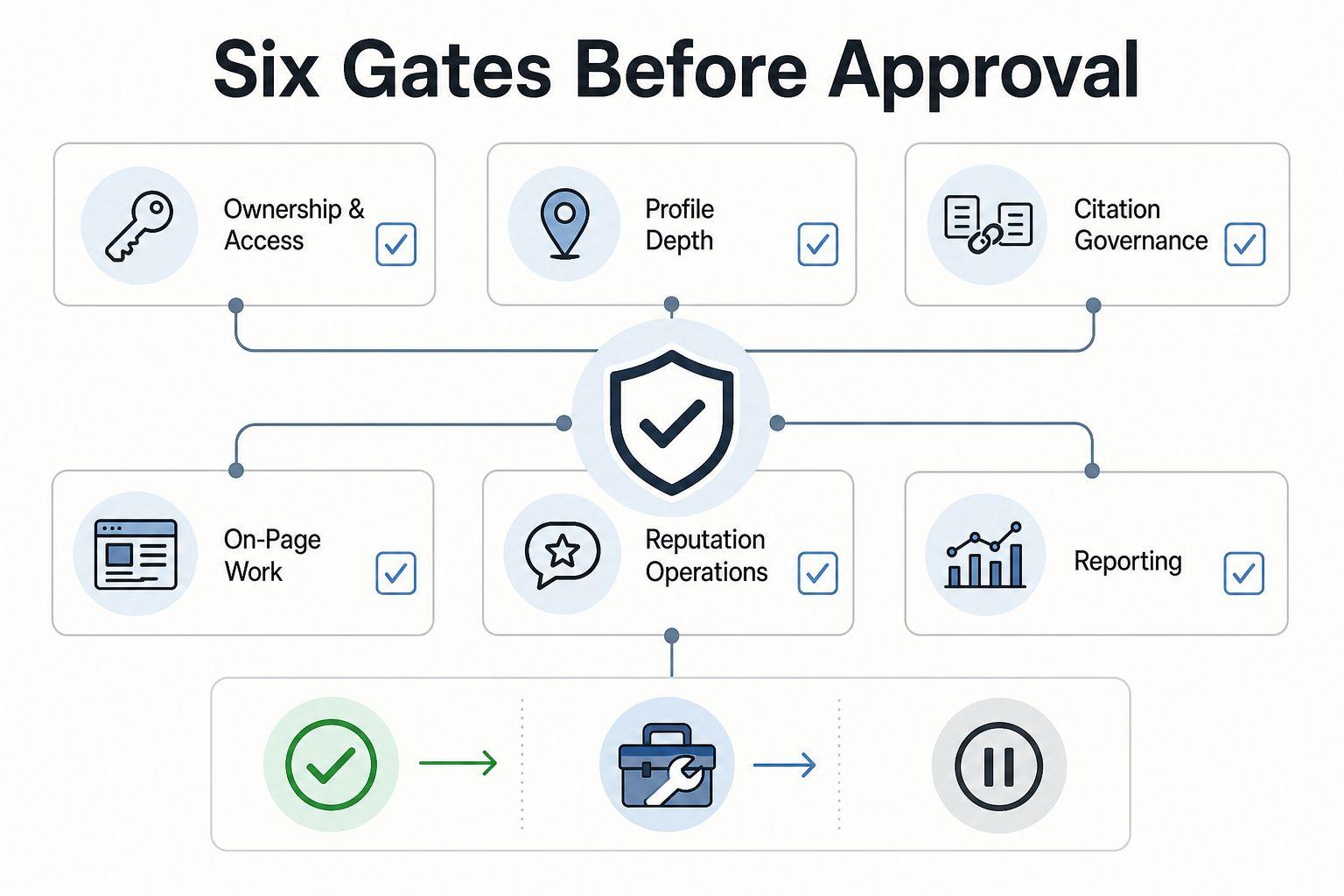
The verdict flips under two conditions. Where internal capability already covers most of that ground, a managed package duplicates cost without adding proportional value. Where the actual need is narrow, such as a citation cleanup or a profile remediation after a suspension, a full package overspends on scope the business does not require.
Score the proposal currently on the table against six dimensions: ownership and access, profile depth, citation governance, on-page work, reputation operations, and reporting. A scope that fails two or more of them is not ready for approval, whatever the package label says.
| Situation | Right Choice |
|---|---|
| No internal capacity for profile, citations, or reviews | Full managed package covering all six dimensions |
| Strategy or specialist technical fix is the real gap | Freelance consultant engagement |
| Internal team has bandwidth and change-control discipline | Internal execution with periodic audit |
| Listings are inconsistent but profile and site are otherwise sound | Profile and citation remediation engagement |
| Measurement and attribution are not yet in place | Postpone new spend until reporting baseline exists |
About the Author