

Ranking for more solar keywords rarely produces more installed systems. A residential solar page can climb for a dozen generic terms, “solar panels,” “clean energy,” “renewable power,” and still send nobody to a consultation form, because none of those terms carries the intent of a homeowner comparing quotes.
The pages that convert usually rank for fewer, narrower queries. That is the uncomfortable part.
What separates a portfolio of pages that generates leads from one that generates traffic is not volume of content. It is whether every page was built to answer a specific decision a homeowner is making, at the specific moment they are making it.
A Lead Baseline Comes From the Search Landscape
Organic SEO for residential solar installation is the work of earning measurable visibility for local customer acquisition, not the work of publishing broad commentary about clean energy. A blog post about grid decarbonization might perform well in a content calendar and do nothing for a homeowner trying to decide whether their roof qualifies for a system. The distinction matters because the two activities consume the same hours and produce entirely different outcomes.
A working baseline needs five figures tracked together rather than separately:
- Organic traffic to residential service pages
- Organic search ranking for intent-specific terms
- Conversion rate from page visit to consultation request
- Local pack ranking for service-area searches
- Consultation requests those channels actually produce
None of this analysis asserts what competitors are doing in any named region. Search behavior in Sacramento, Austin, Phoenix or anywhere else is not visible from a single-location, single-language SERP review, and claiming otherwise would be guessing dressed as insight. The baseline above applies to regional clean energy providers generically, because that is what the evidence supports.
Keyword Demand Maps to Page Intent
A single target like “solar panels” hides at least four different homeowners at four different stages, and optimizing one page for all of them satisfies none. Someone searching “solar panel cost for a 2,000 sq ft home” is not in the same decision moment as someone searching “best solar installer near me,” and a page that tries to answer both usually answers neither convincingly.
Breaking the demand into distinct intent categories, and assigning each a distinct page purpose, is the first real lever:
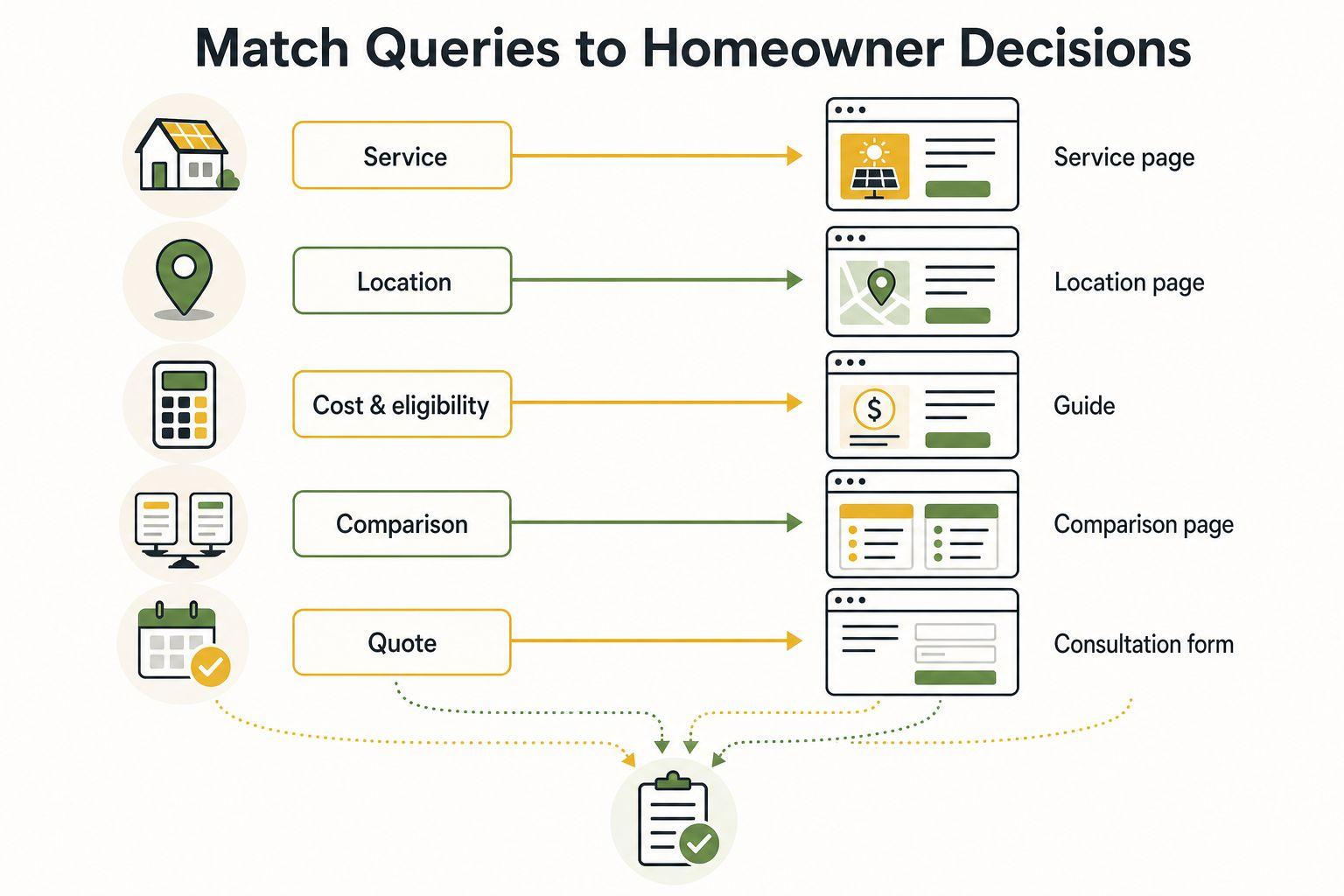
- Service intent (“residential solar installation,” “solar panel installer”) maps to core service pages that must show process, timelines and system types.
- Location intent (“solar installer [city/region]”) maps to location or service-area pages that prove local relevance without duplicating the core service page word for word.
- Cost and eligibility intent (“solar panel cost,” “solar tax credit eligibility”) maps to pricing and incentive guides that reduce pre-consultation friction.
- Comparison intent (“solar vs. traditional energy,” “leasing vs. buying solar”) maps to comparison content that supports a decision already in progress.
- Consultation intent (“get a solar quote,” “schedule a solar consultation”) maps directly to conversion pages and forms.
Two terms surface repeatedly in solar SEO discussion, the 33% rule and the 20% rule, and both deserve caution rather than confident explanation. Neither has a validated, sourced definition in the research available here, and a provider that publishes a claim about either without confirming its origin risks publishing something incorrect under its own name. Treat both as flagged gaps, not settled facts, until a checkable source exists.
On-Page Proof Is the Residential Answer
Before any page can rank or convert, it has to answer one implementation question directly: what does a homeowner need to see, on this page, before they will hand over their address and roof details? Ranking without that proof produces impressions. It does not produce consultation requests, and the two are not interchangeable no matter how the traffic report is read.
Service Pages Match Installation Intent
A residential installation service page earns its ranking through specificity, not enthusiasm. The page title and primary heading should name the service plainly, “Residential Solar Panel Installation,” rather than a slogan. Service-area relevance has to be built in without creating a doorway page, meaning the same paragraph structure copied across twenty city pages with the city name swapped.
Real service-area relevance references local permitting steps, utility interconnection processes or regional roof types, details a duplicated template cannot carry. The page itself needs to walk through the installation process in sequence:
- site assessment
- system design
- permitting
- installation
- inspection
- activation
It needs system-fit considerations (roof orientation, shading, panel type suited to the climate) stated plainly rather than implied.
Proof signals belong here too: certifications, warranty terms, completed project counts, review excerpts, not as decoration but as the evidence a skeptical homeowner is actively looking for. Internal links from this page should route to the supporting content below it, and the consultation call-to-action needs its own tracked event, separate from a generic “contact us” click, so its performance can be measured rather than assumed.
Content Assets Resolve Pre-Consultation Questions
A homeowner rarely converts from the service page alone. They read the service page, then look for cost ranges, financing options, roof suitability criteria and comparisons before they commit to a form. That is the gap a cluster of supporting content is meant to close.
A working structure looks like one residential installation service page, supported by:
- a cost and financing guide
- a roof and system suitability guide
- and a comparison piece addressing leasing versus ownership, or solar versus standard utility billing
Each supporting page links back to the service page and forward to the consultation form.
None of them duplicate the service page’s content. This is the shape that most guides for solar seo describe as a cluster model rather than a single optimized page, and the distinction is not cosmetic: a cluster earns ranking across the intent spread mapped earlier, while a single page cannot.
Map-Pack Visibility Decides Local Relevance
Local pack ranking is not a vanity metric sitting apart from the sales pipeline. It sits directly upstream of organic traffic, conversion rate and the volume of solar consultation requests a business actually receives, because most homeowners searching for an installer near them never scroll past the map results.
A 2026 solar-energy SEO report found that the business holding Google Maps position 1 captured 35% of local clicks, while the business at position 4 captured only 6%. That is not a claim about any specific city’s competitive field. It is a benchmark that makes the difference between position 1 and position 4 a measurable revenue gap rather than a cosmetic one, which is what makes tracking local pack position worth the effort in the first place.
Getting there follows a defined sequence, not a single fix:
- Confirm business details are accurate everywhere they appear, name, address, phone number and service categories consistent across every listing.
- Complete Google Business Profile optimization, filling every relevant field, choosing accurate service categories, and keeping business profile hours and service areas current.
- Add service evidence, photos of completed installations, service descriptions matching the site’s own service pages, and posts reflecting real activity.
- Govern review responses deliberately, replying to both positive and negative reviews in a way that demonstrates active management rather than silence.
- Maintain citation consistency across directories so no conflicting address or phone number undermines the profile Google is already ranking.
The Business Profile Supports Local Intent
A Google Business Profile that is complete but generic, filled in but not maintained, tends to stall below the top three positions where the click share drops sharply. Consistent updates and accurate categorization matter more than any single one-time optimization pass, because the profile is compared against competitors who are also updating theirs.
Location Pages Earn Relevance Without Duplication
Service-area pages support the business profile rather than replacing it. A location page that repeats the core service page with a city name substituted signals thin content to both users and search engines. A location page that references genuine local specifics, permit timelines, utility programs, climate-relevant system choices, earns the relevance the profile alone cannot carry.
A Conversion Safeguard Sits Behind Site Performance
A page can rank acceptably and still lose the homeowner before the form loads. Mobile usability failures, slow rendering, and forms that silently fail to submit are the most common reasons a good ranking produces a disappointing consultation count.
The diagnostic path starts with the visitor’s own experience:
- Does the page render cleanly on a phone?
- Does it load fast enough that a homeowner does not abandon it?
- Does the consultation form actually fire a trackable event when submitted?
From there, check that pages are properly indexed rather than accidentally blocked, that no broken internal links strand a visitor mid-journey, and that duplicate content between service and location pages is not diluting relevance. Heavy, uncompressed images slow every one of these steps at once.
Each fault has a distinct consequence. A slow-loading service page loses visitors before they see the proof signals that would have convinced them. A broken link mid-cluster strands a homeowner who was ready to move from cost guide to consultation form. A duplicate location page can suppress the exact page meant to rank locally.
Technical fixes are necessary but not sufficient on their own; their success should be validated against organic traffic, ranking position and conversion-rate movement afterward, not assumed from the fix itself. A page that loads faster but still shows no ranking or conversion change has not actually been fixed for the reason that mattered. What remains after the technical layer is whether the domain carries enough outside authority for these fixed, fast, well-targeted pages to compete at all.
Sector Authority Comes From Useful Evidence
Authority for a residential solar provider is not built by acquiring links in bulk. It is built by publishing something other sites, and homeowners, find genuinely worth citing:
- a cost calculator using real regional utility rates,
- an explainer on roof suitability that goes beyond marketing copy, or
- a substantiated local partnership with an installer network or a utility program, where that relationship can actually be verified rather than asserted.
Content ideas that tend to earn citations share a pattern: they answer a question a homeowner or a journalist would otherwise have to research from scratch. A guide comparing financing structures with real numbers. A breakdown of permitting timelines by jurisdiction. A tool that estimates system size from roof measurements. Each of these has a natural reason to be referenced elsewhere, which is where a durable link profile actually comes from.
Three criteria decide whether a piece of authority-building content is worth the effort:
- topical relevance to residential solar decisions
- editorial merit sufficient that another credible site would choose to reference it
- and a traceable impact on referral traffic or ranking, not solely on link count
A hundred low-relevance links move nothing. A handful of relevant citations from sources homeowners already trust can move both ranking and conversion rate simultaneously, and that is the outcome the effort should be judged against.
Reporting Is an Optimisation Decision
Whether organic search is worth the ongoing investment is answered by comparing qualified organic acquisition against measurable alternatives, not by citing a general guarantee that SEO works. A 2026 solar SEO benchmark report estimated that SEO-generated leads cost 60 to 80% less than paid advertising over a twelve-month window.
That figure is a benchmark for prioritization, not a promised outcome for any specific provider, and treating it as a guarantee is how reporting stops being useful.
Separate Visibility From Demand
Impressions and organic search ranking measure whether the page is being seen. They say nothing about whether it is being acted on. A page can rank on page one for a valuable term and still convert at a fraction of a percent, and a report that stops at ranking position will miss that entirely.
Connect Rankings to Consultation Value
The chain that matters runs from impressions and ranking, through organic traffic, into conversion rate, local pack ranking and finally consultation requests. Each link in that chain has to be checked separately, because a strong number at one stage can mask a weak number at the next.
If a page ranks well but converts poorly, the fix is usually on the page, not in the search strategy that got it there. If a page converts well but gets little traffic, the fix is visibility, not messaging. Reporting that separates these two failure modes tells the executor whether to revise a page, retire it, consolidate it with a stronger performer, or expand the cluster around it. Reporting that blends them into a single traffic chart tells the executor nothing they can act on.
The Next Operating Model Comes Into View
Isolated keyword reports and unmeasured content output are likely to keep losing ground to decision-led measurement, where every page, listing and asset is tied to a specific stage in the consultation path rather than to a ranking number in isolation. That is a forecast about where reporting discipline is heading, not a claim about what any single provider has already achieved.
What replaces the old reporting habit is a small set of situational decisions, made repeatedly as the numbers shift. The providers still running separate keyword trackers next to separate lead spreadsheets will keep mistaking one for the other. The ones who tie ranking movement to consultation volume, page by page, will be the ones deciding what to fund next with actual evidence instead of a hunch about what worked last quarter.
| Situation | Right Next Choice |
|---|---|
| Weak local pack ranking despite a complete profile | Audit citation consistency and add fresh service evidence before touching the website |
| High impressions, low consultation conversion | Rework the page’s proof signals and CTA tracking, not its keyword targeting |
| Thin residential service coverage | Build the supporting cluster (cost, suitability, comparison) around the existing service page |
| Low-authority pages with accurate content | Pursue a small number of genuinely citable assets, not broad outreach for volume |
| Strong metrics with unclear reporting | Rebuild the chain from impressions to consultation requests before making any new claim about ROI |
About the Author