

The cheapest entry tier is usually the most expensive mistake on a pricing page. A low-priced plan looks like the obvious lever for acquisition, right up until someone calculates what it costs to sell, support, and retain the people who buy it. Growth teams optimize the top of the funnel and never check whether the tier at the bottom of it can support its own weight.
That gap is not a pricing problem in the abstract. It is a sequencing problem. Segments get defined too late, tiers get drawn around features instead of value, and the acquisition math arrives after the ladder is already live and hard to unwind.
Fixing it does not require a new price point. It requires working the decisions in the right order, starting with what a tier is actually for.
Define the Tier Ladder Around Customer Value
Tiered pricing works by offering distinct packages at different price points and letting customers self-select into whichever one fits their need, rather than forcing every buyer onto one flat fee or billing purely by consumption. That self-selection is the entire mechanism. It only functions if the tiers are built around genuine differences in what customers value, not around whichever features happened to ship first.
What Signals Actually Separate Segments
A segment is not a company size bracket. It is a group of accounts that need the same job done and would pay a similar amount to get it done. The signal worth tracking is not “how big is this account” but “what outcome are they buying, how often do they need it, and what would make them pay more for it.” Two accounts of identical size can sit in entirely different segments if one uses the product occasionally and the other runs it as a daily workflow with several people touching it.
What Belongs in Each Rung of the Ladder
A workable ladder runs two to four tiers, each with the same six attributes decided in advance:
- Target segment: the group of accounts this tier is built for
- Job or value signal: the outcome that defines why they buy
- Capability included: what the tier actually does
- Quota or usage limit: the cap that keeps the tier honest
- Price point: what the segment has shown it will pay
- Upgrade path: how this customer is expected to outgrow the tier
Annual commitments commonly carry a discount in the 15 to 20 percent range as an added incentive to lock in.
This is different from flat-rate access, where one fee covers the full product regardless of usage or seats, and different again from pure consumption billing, where the invoice tracks actual use with no fixed package at all. Tiered pricing sits between those two: fixed packages, but multiple of them, each earning its price from a distinct value signal rather than from raw usage alone.
Separate Segments Before Assigning Features
Skipping the segmentation step does not save time, it just moves the cost downstream. Tiers built straight from a feature list tend to overlap, so two adjacent plans end up solving the same problem for the same buyer, and the sales motion degrades into discounting whichever tier the prospect resists least.
Before any feature gets assigned to any tier, four checks should produce a clean answer:
- Outcome grouping: which accounts are buying the same result, regardless of how they describe it
- Usage intensity: whether the segment’s use is occasional, steady, or central to a daily workflow
- Control and collaboration needs: whether the job requires permissions, approvals, or multiple seats working together
- Willingness to pay: what this segment has actually paid, or clearly signaled it would pay, for the outcome above
The minimum proof of a genuinely distinct segment is a difference in at least two of those four, not one. A single differing attribute is usually a feature preference, not a segment boundary, and building a tier around it is how ladders end up with three plans that all sell the same thing at three different prices.
Test Whether Acquisition Economics Support Each Tier
Once the segments are real, the question stops being “what should this tier include” and becomes “can this tier pay for itself.” That question has to be asked per tier, not once for the business as a whole. A blended CAC and a blended LTV can look perfectly healthy while hiding one tier that loses money on every signup it wins.
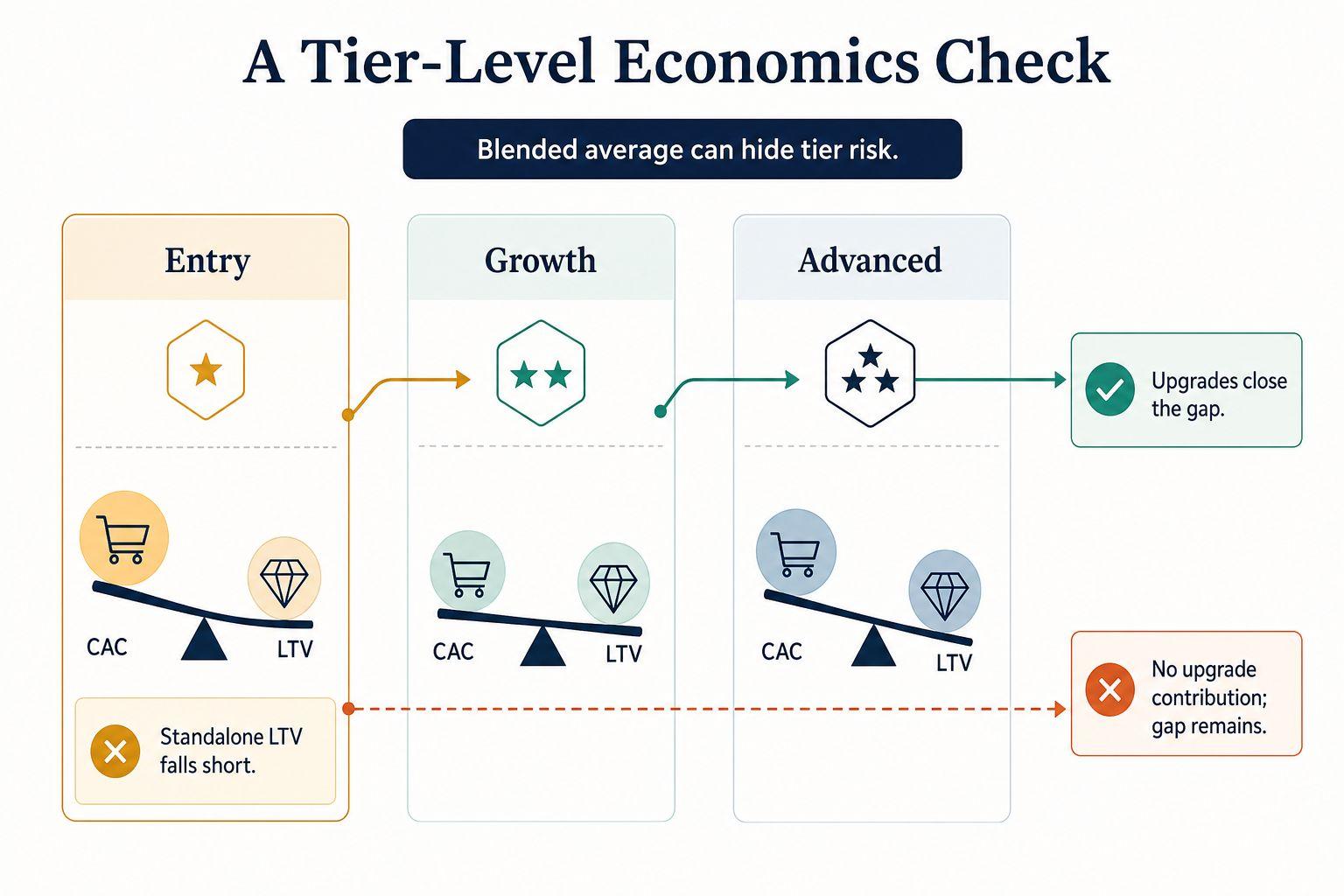
The calculation is the same shape for every rung of the ladder. For each tier, work out the acquisition cost specific to the channels and sales motion that fill it, and the retained revenue behavior of customers who land there.
From those two comes the resulting lifetime value. Add the service and support burden that tier generates, plus any revenue it contributes indirectly by upgrading customers into a higher plan later. Lay those side by side and the comparison across tiers becomes visible in a way the company-wide average never shows.
A 2025 pricing analysis on tier-level cohort performance makes a specific, useful point here: some tiers fall below a 3:1 LTV to CAC ratio even when the top-line numbers for the business look fine.
The analysis recommends calculating LTV and CAC separately for each tier precisely because an entry plan can look attractive in absolute terms while being unprofitable on its own.
That ratio is worth treating as a diagnostic flag, not a target to hit exactly. A tier under 3:1 is a prompt to look closer, not an automatic verdict that the tier is wrong.
Three outcomes follow from that closer look. If the entry tier genuinely loses money standalone, the fix is not necessarily to raise its price: it may be sound as a funnel step, provided a higher tier is demonstrably funding the acquisition cost through upgrades. If no higher tier is funding it, the entry tier needs a smaller quota, a narrower feature set, or a higher price, in that order of preference.
And if the numbers look fine but rest on an assumed retention curve nobody has actually observed yet, the number is not evidence. It is a hypothesis waiting on a cohort.
Draw Boundaries That Create a Reason to Upgrade
Segment findings and tier economics only matter once they turn into boundaries a customer can feel. A ladder where every tier can do almost everything gives buyers no reason to move up it, and a ladder where the entry tier is crippled gives them no reason to buy in at all.
The sequence for setting those boundaries runs in a fixed order:
- Reserve the differentiated capability for the job the higher-value segment actually does, not for a feature that merely looks premium
- Use quotas or consumption limits wherever value scales with use, since a usage cap converts naturally into an upgrade trigger once a customer grows into it
- Protect a usable entry experience, because a tier that cannot complete its core job will not convert or retain regardless of price
- Make the next tier’s gain legible in the language of the job it solves, not as a longer feature list
Where Boundaries Get Checked for Overlap
Each boundary drawn this way needs a cannibalization check before it ships. Does this limit push the target segment upward, or does it just as easily push a higher segment downward into a cheaper plan that now does enough for them? That check is not a hypothetical worry, it is a direct read on whether the segmentation work in the earlier stage was accurate.
Position the Ladder Against the Available Alternatives
A ladder that makes internal sense can still fail in the market if it is priced by copying a competitor’s number rather than by comparing what each option actually offers.
The useful comparison is not “what do they charge,” which invites matching a price without understanding what sits behind it.
It is a comparison across a small set of dimensions instead:
- the value metric the product charges on
- what commitment is required to get started
- the claim that makes this product worth choosing over a flat-rate or usage-only alternative
- the specific event that should trigger an upgrade
Held up against a flat-rate competitor, the differentiation claim usually rests on the ability to start cheap and scale price with actual usage, rather than paying full freight from day one. Held up against a pure consumption-billed alternative, the claim usually flips: predictability of the invoice becomes the reason to choose the tiered product, since the customer knows what they will pay before the month starts.
Documenting that comparison in writing forces a decision that copying a competitor’s price point avoids. A price copied without its underlying value metric imports someone else’s economics into a ladder that has none of the same support behind it.
The reason a customer would choose this product over the alternative gets lost in the process.
Run Pricing Experiments Through Conversion And Cohorts
None of the previous decisions should be treated as final once they ship. They are hypotheses, and the ladder needs a way to test them without setting fire to the whole packaging model in the process.
The loop that works is narrow by design. Pick one packaging or price hypothesis at a time: a new quota on one tier, a repositioned feature boundary, a price change on a single plan. Define exactly which tier and which incoming audience the change touches. Measure conversion into that tier and how the mix across tiers shifts as a result.
Then wait, because the real signal is not in week one.
The cohort view is where the actual answer lives: retention over the following months, churn concentrated in any particular segment, and whether upgrades and expansion revenue move in the direction the hypothesis predicted. Changing price, packaging, and acquisition channel simultaneously destroys the ability to read any of that, since a shift in conversion could belong to any of the three. One variable, one tier, one measured cohort. The test produces evidence to weigh, not a verdict that closes the question permanently.
Make the Next Tier Decision From the Signal
The smallest useful step is not a repricing project. It is picking one tier, populating its acquisition cost and lifetime value inputs with real numbers, and reading what that single worksheet says before touching anything else on the page.
That one-tier exercise will usually point toward one of a small number of moves, and the signal decides which:
| Situation Observed | Next Choice |
|---|---|
| Segment fit is unclear for this tier’s buyers | Re-run the segmentation checks before changing price or features |
| Two tiers overlap in what they solve | Redraw the feature or quota boundary, not the price |
| Tier-level LTV to CAC is weak on its own | Check whether a higher tier funds acquisition before cutting the entry price |
| Conversion into the tier is low | Test the value metric or commitment level, one change at a time |
| Churn appears shortly after purchase | Investigate the entry experience before assuming the price was wrong |
None of these outcomes require rebuilding the ladder. Each one is a single, reversible move that can be verified against the next cohort. The worksheet for one tier, filled in honestly today, is worth more than a plan to reprice everything next quarter.
About the Author