

What does a monthly retainer actually owe a business, beyond the list of tasks printed on the invoice? Most proposals answer that question with a service count. Almost none answer it with a reason.
That gap is where evaluators lose the argument internally, not because the package was wrong but because nobody wrote down what it was supposed to prove.
A bundled scope can look identical whether it fits the business or not. The difference only shows up once someone asks what each line is for.
What Must a Comprehensive Marketing Package Solve Before Services Are Chosen?
A comprehensive package is not a maximal one. It is a coordinated campaign strategy development system in which every included service has a stated commercial job, a named owner, and a checkpoint tied to a business outcome. Breadth and fit are not the same test, and a proposal that conflates them is asking to be approved on volume rather than reasoning.
The first executable step happens before any vendor conversation: write down the commercial goal, the target audience, the customer-journey stage the business is weakest at, the internal capacity already available, and the growth outcome the package has to move. This is a document, not a mental note. It should be short enough to fit on one page and specific enough that a stranger could read it and know what “success” would look like in six months.
Baseline capacity matters more than most evaluators give it credit for. A business with an internal designer and no analyst needs a different package than one with neither. Skipping this step is how businesses end up paying for services that duplicate work already happening in-house, or worse, paying for coordination of channels nobody on staff can act on.
Comparing marketing packages side by side only becomes useful once this internal document exists, because otherwise the comparison has nothing to measure fit against beyond price and page count.
Two proposals can list the same six channels and still be unequal offers. One assumes the business already has brand assets and a functioning site; the other has to build both before any campaign runs. Without the baseline document, that difference is invisible until the first invoice.
The output of this step is a constraint set: what the package must address, what it does not need to touch, and what would make the spend defensible in a budget review three or six months out.
Which Marketing Components Belong in the Scope, and Which Do Not?
Once the constraint set exists, scope decisions split into three functions that rarely get named separately in a proposal: demand capture, demand creation, and conversion or retention work. Treating them as one undifferentiated “digital marketing” line is where unnecessary deliverables hide.
Demand Capture and Demand Creation
Demand capture covers channels that intercept people already searching, such as search engine optimization and paid search. Demand creation covers channels that build awareness before a search happens, such as social content and display. A business early in a category with low search volume is buying demand creation whether the proposal says so or not, and no amount of search optimization will substitute for it.
Conversion, Retention, and Reporting
Website design, reporting, and reputation management sit downstream of both. They are the layer that decides whether captured or created demand actually converts, and whether it repeats.
| Component | Primary Job | Best-Fit Condition |
|---|---|---|
| SEO | Capture existing search demand | Measurable search volume for the category exists |
| PPC | Capture demand immediately, test messaging | Budget can sustain testing past the first month |
| Social media | Build awareness, sustain engagement | Audience is active on the platform chosen |
| Website design | Convert traffic once it arrives | Site has a specific, named conversion failure |
| Reporting | Show attributable results against goals | Any paid channel is running |
| Reputation management | Support conversion via trust signals | Review volume or complaints affect close rate |
| Geo-targeted campaigns | Capture local intent | Business serves defined physical service areas |
Neighborhood landing pages and other location-specific activity are conditional additions, not default inclusions, and they should only appear in scope when the business genuinely competes on local intent. Where location marketing touches personal data collection or email contact, GDPR, the CAN-SPAM Act, or CCPA become relevant scope checks rather than universal boilerplate, and a proposal should say which one applies and why.
How Should Goals and Audiences Determine the Channel Mix?
A written goal-to-channel mapping is the second standalone step, separate from the constraint document above. It takes one goal, such as generating qualified leads from a defined buyer segment at the consideration stage of the journey, and connects it to a limited set of activities, the person accountable for each, and the signal that would show it working.
That mapping usually rules out channels rather than adding them. A business chasing qualified leads from a narrow B2B segment rarely needs broad social awareness spend. A business needing category awareness before any search exists rarely benefits from heavy search-term bidding yet.
The test for any proposal is simple: does it state the assumption that makes each channel relevant, or does it just list the channel? A proposal that says “social media” without saying which audience segment, which platform, and which stage of the journey it serves has not done the mapping. It has done inventory.
What Must Be Included and Excluded From a Monthly Offer?
Counting deliverables is not the same as understanding scope. A package advertised at eight posts and one email campaign per month, or twenty posts with four campaigns and automation flows at a higher tier, as seen in published U.S. package pricing, tells a buyer how much output exists without telling them whether that output does anything for the stated goal.
A workable scope checklist separates responsibility from volume:
- Strategy: who defines the campaign approach and how often it is revisited
- Production: what content, creative, or code gets built each month
- Channel management: which platforms are actively managed, day to day
- Optimization: what gets tested and adjusted, and on what cadence
- Reporting: what is measured, how often, and in what format
- Meetings: how many scheduled check-ins, and who attends
- Onboarding: what setup work happens before the first deliverable
- Access and approval: who holds account credentials, and who signs off before anything goes live
Exclusions deserve equal visibility. Monthly ad spend paid directly to platforms, major creative production such as video, website redesign, and management of any advertising platform not named in the scope should be stated as excluded, not implied by omission. A 2026 package description for U.S. clients does this explicitly, ruling out ad spend and redesign work by name rather than leaving buyers to infer it.
A bronze or silver tier that only shrinks the deliverable count without disclosing the channel limit is not offering a smaller version of the same coverage. It is offering a different scope wearing the same name.
How Can Pricing Be Compared Without Mistaking Cost for Value?
Two invoices of equal size can fund entirely different amounts of actual work. Separating the management fee from media spend, one-time setup, creative production, technology or software cost, and the internal staff time still required is the only way to compare them honestly. A package that looks cheaper on the management line but pushes creative and setup costs onto the buyer is not necessarily the lower-cost option.
Budget allocation should trace back to the goal-to-channel mapping, not to a generic percentage split. A channel included because the mapping justified it deserves funding; a channel included because it was bundled does not.
Weighing In-House, Freelance, and Agency Models
Full-service marketing, in-house teams, freelance marketers, and specialized agencies each trade coordination burden against specialist depth differently. In-house staff carry institutional knowledge but often lack channel-specific depth across six disciplines at once.
Freelancers offer deep, narrow skill at lower overhead but leave coordination to the buyer. A full-service arrangement centralizes coordination but concentrates dependency on one vendor, and a specialized agency trades breadth for depth in one channel instead. None of these is universally superior. Each fits a different internal capacity and risk tolerance, and the goal document from the first step is what should decide which trade-off the business can actually absorb.
Which Measures Make a Marketing Package Accountable?
Activity reporting, meaning post counts and impressions, is not commercial evidence. Commercial evidence connects activity to a business outcome the goal document named, and a proposal should be judged on whether it commits to that connection before work begins.
A proposal scorecard worth requesting in writing includes:
- Conversion rate: the share of traffic or leads that complete the defined action
- Cost per acquisition: total spend divided by acquisitions, by channel
- Return on investment: net return against total cost, not just media cost
- Customer lifetime value: expected revenue per customer over a defined period
- Engagement metrics: only where tied to a stated conversion hypothesis
- Traffic sources: broken out by channel, not aggregated
- Lead-quality definition: what counts as qualified, agreed before reporting starts
- Reporting cadence and review point: how often, and when scope gets reassessed
Multi-channel attribution rarely produces a clean single answer, and any proposal presenting one channel as the sole cause of a conversion across a multi-touch journey is overstating certainty. The same caution applies to A/B tests run on small samples over short windows.
A results deck should say what it does not yet know, not just what moved.
What Should Onboarding, Ownership, and Change Control Look Like?
A workable campaign system runs in a visible sequence: the business case and goal document lead to a baseline and access review, which leads to launch, which leads to a scheduled review, which leads to a documented scope adjustment if the evidence supports one. Skipping the access review is the most common failure point, because it is the one step vendors have the least incentive to insist on.
Every:
- account
- analytics property
- ad platform login
- domain registrar
- creative file
- and reporting dashboard should remain visible and accessible to the business at all times, not held exclusively by the vendor.
Implementation support — should have a stated response time
approval steps — should have a stated turnaround
and escalation — should have a named path if either slips.
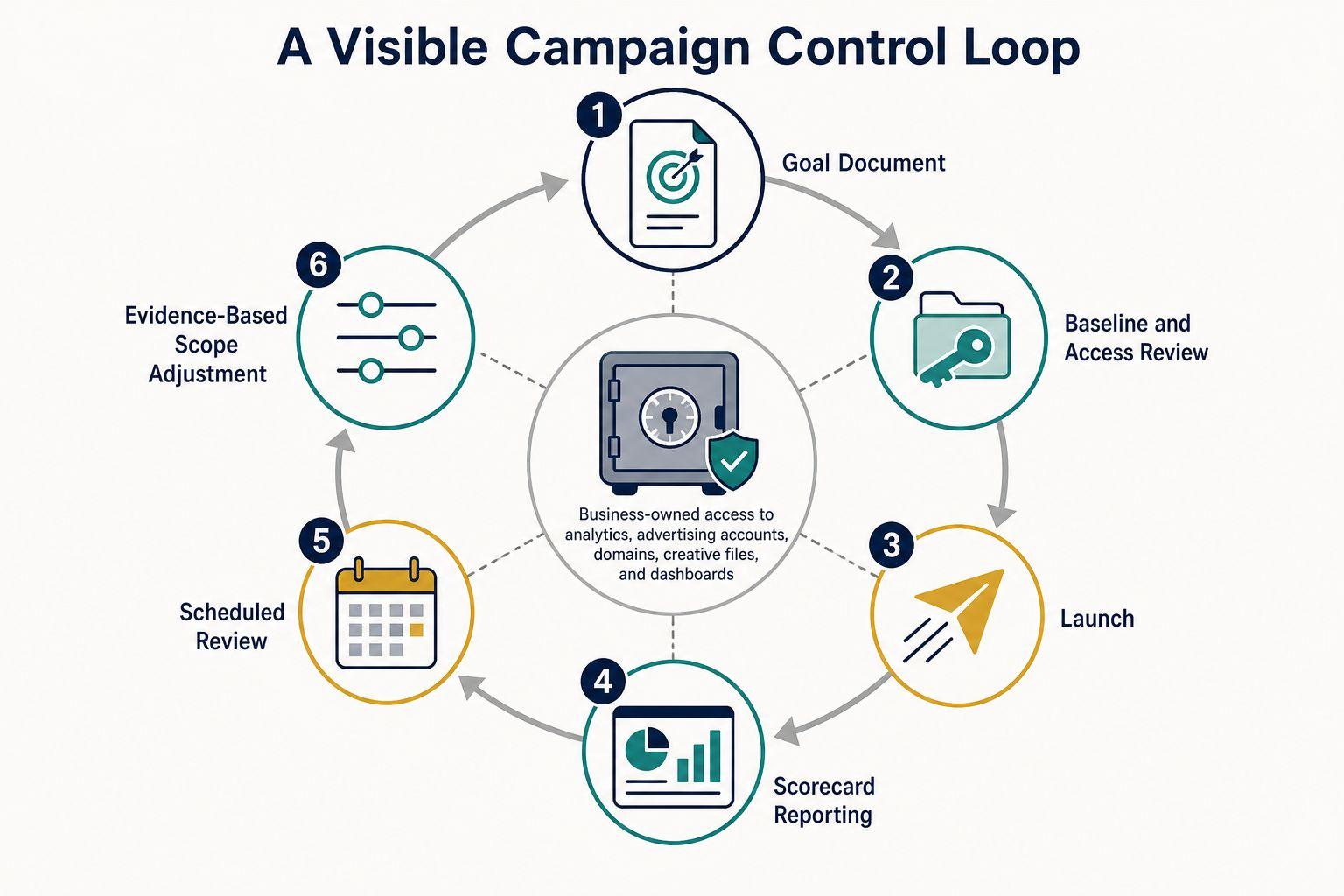
Adding, removing, or reallocating a service after the agreed learning period should require evidence from the scorecard, not a renewal date alone. A channel that missed its stated signal at the review point is a candidate for change, regardless of how much of the contract term remains.
What Is the One Request to Send Before Choosing a Package?
Every decision above collapses into a single action: ask for a tailored recommendation built from the goal document, not a prebuilt bundle selected off a pricing page. A vendor willing to build from the constraint set will show their reasoning. One who cannot will default back to tiers and deliverable counts, which is itself useful information about how the engagement will run.
That request does not need to be long. It needs to force four commitments onto paper before any commercial conversation continues. Send this today, before requesting a proposal:
State our commercial goal and target audience in one sentence each. List included services and the services deliberately excluded, and why. Show the budget split between management, media, and setup, and who owns each account. Name the measures you will report and the date we will review them together.
About the Author