

What does a proposal have to prove before a monthly management fee means anything at all?
Most PPC proposals arrive with a headline number and a list of adjectives. Full-service. Dedicated account manager. Transparent reporting. None of that number, and none of those adjectives, answers the only question that matters to whoever signs the budget: what direct, measurable return does this specific structure produce, and how would anyone outside the agency verify it.
That question sits underneath every comparison of package price, ad spend split, and reporting cadence that follows. It is answerable, but only once the proposal is broken into pieces that can be checked independently rather than accepted as a bundle.
What Should Be Compared Before Any PPC Package Price?
A paid-search package is, functionally, an arrangement covering three things: how much money goes to the platform as ad spend, how much goes to the provider as a management fee, and what work that fee is meant to buy.
That third piece includes campaign build, ongoing optimization, and reporting. Paid search itself, primarily Google Ads and Microsoft Advertising, differs from adjacent PPC channels like Facebook Ads or LinkedIn Ads mainly in intent: paid search targets an existing, expressed demand, while social platforms interrupt attention to create demand. A comparison of packages should hold that distinction steady rather than blending the two into one generic “PPC” line item.
Six dimensions recur across proposals regardless of provider size: the economic split, the scope of included work, the measurement plan, who controls the account and data, what reporting actually contains, and whether any of it fits the business’s sales cycle and margin. Pricing alone tells an evaluator almost nothing about four of those six.
| Dimension | Proof to request | Risk if absent | Effect on direct return |
|---|---|---|---|
| Economic split | Itemized ad spend vs. management fee | Spend hidden inside fee, inflating perceived cost | Cannot calculate true cost per acquisition |
| Included work | Written scope of optimization tasks | “Set and forget” campaigns billed as active management | Quality score and CTR stagnate without adjustment |
| Measurement | Conversion action list and tracking method | Reporting on clicks, not outcomes | Return on ad spend cannot be verified |
| Operational control | Account and data ownership terms | Provider retains data on exit | No continuity if the relationship ends |
A package that scores well on price but poorly on scope or control is not cheaper. It has simply moved the cost somewhere less visible, usually into the evaluator’s own time spent reconstructing what happened after the fact.
What Does a PPC Package Really Cost Beyond Its Monthly Fee?
The monthly fee quoted in a proposal is rarely the full cost of running paid search. Ad spend, the money paid directly to Google Ads or Microsoft Advertising for clicks and impressions, is a separate line from the management fee, which compensates the provider for building, adjusting, and reporting on campaigns.
Some packages also carry a one-time setup fee covering account structure and initial keyword build. Others add charges for conversion-tracking implementation, landing-page development, or creative production for adjacent channels. Treating all of this as one number obscures where the money actually goes.
Cost per acquisition and return on ad spend are the two measures most often used to judge whether that combined cost was worthwhile, but neither has a universal “good” value.
A cost per acquisition that looks high for a low-margin retail product might be excellent for a service with a high lifetime value. Return on ad spend has to be set against the business’s own margin and average conversion value, not against a number quoted in someone else’s case study.
This is where a low management fee becomes a false economy.
A provider charging less per month but excluding conversion-tracking setup, landing-page testing, or ongoing bid optimization may leave the account under-measured and under-managed. The client ends up paying the same ad spend for worse targeting, which raises the real cost per acquisition even though the invoice looks smaller.
A useful discipline: before comparing two proposals by total monthly cost, separate each into ad spend, management fee, and one-time costs. Then ask what optimization work the management fee is actually buying. Two packages at the same headline price can represent very different amounts of ongoing work, and two packages at different prices can produce the same amount of usable optimization once setup and tracking costs are accounted for.
What Is Actually Included in PPC Packages?
A scope and a promise are not the same document. “We manage your campaigns” is a promise. A list of specific deliverables, each with a named owner and a review point, is a scope, and only a scope can be checked against an invoice later.
Providers structure their ppc packages differently, but a defensible proposal should name each of the following explicitly rather than folding them into general language:
- Campaign management: which campaigns are built, adjusted, and paused, and how often.
- Keyword research: initial build plus ongoing expansion or negative-keyword pruning.
- Bid management: manual adjustment, automated strategy, or a mix, stated clearly.
- Ad and landing-page responsibility: who writes ad copy and who owns landing-page changes.
- Performance auditing: a scheduled review of account health, not only monthly totals.
- Conversion tracking and customer support: setup ownership and response time for account questions.
Anything not named in that list should be assumed absent, not assumed included.
Which Metrics Show Whether Paid Search Is Producing Direct Return?
Clicks and impressions describe attention, not outcome. Judging a package by traffic volume alone rewards a provider for spending the budget, not for spending it well. The metrics that actually connect spend to business result are conversion-based, and each one maps to a different part of the package decision.
What Conversion Metrics Actually Measure
Conversion tracking is the mechanism that records a defined action, a purchase, a form submission, a call, as a result of an ad click. Conversion rate is the share of clicks that complete that action. Cost per acquisition divides spend by the number of conversions, giving a per-result cost that can be compared against the business’s own margin. Google Ads documentation describes its Conversions column as counting conversions across primary conversion actions, which is why the conversion actions selected in setup determine what that column actually means.
What Diagnostic Metrics Reveal About Account Health
Click-through rate and quality score diagnose the campaign before conversion, showing whether ad relevance and targeting are efficient. Return on ad spend closes the loop, tying spend to revenue rather than to a count of actions. A package review that skips the diagnostic layer and jumps straight to return on ad spend will struggle to explain why performance changed.
Who Owns the Account, Data, and Reporting Record?
Polished reporting can sit on top of an arrangement where the client controls almost nothing. A clean monthly dashboard says little about whether the underlying Google Ads account, conversion data, or tracking pixel belongs to the business or to the agency managing it. A 2026 agency evaluation checklist frames this directly: buyers should confirm who owns the account, the pixel, and the conversion data, along with contract length and offboarding terms, because those rights determine whether performance can be independently verified and whether the relationship can end cleanly.
These are contract terms, not judgments about a provider’s competence, and they should be requested in writing before signature:
- Account access: is the Google Ads account owned by the client, with the agency granted access, or owned by the agency itself?
- Data and pixel ownership: does conversion data and tracking history transfer if the relationship ends?
- Account management terms: who has authority to change budgets, pause campaigns, or approve creative?
- Reporting cadence and contents: what specific metrics appear monthly, and how far back does history go?
- Support access: is there a named contact, and what is the expected response window?
- Contract length and offboarding: what notice period applies, and what is handed over on exit?
Each of these is verifiable before a dollar is spent. None of them require trusting a claim about service quality.
How Should Google Ads and Microsoft Advertising Be Compared?
The same six dimensions applied earlier to a generic package apply again when comparing platforms within paid search. Audience intent differs modestly: Google Ads reaches a larger search volume, while Microsoft Advertising often reaches an audience with different device and demographic patterns, which can shift cost per acquisition for some categories. Available budget affects both similarly, since fragmenting a small budget across two search platforms dilutes the data each one needs to optimize.
Tracking setup, management scope, and reporting should be evaluated per platform rather than assumed to transfer automatically. A conversion action configured correctly in Google Ads does not configure itself in Microsoft Advertising, and a package that claims to manage “search” without naming both platforms separately may only be running one of them with real attention.
Facebook Ads and LinkedIn Ads
sit outside this comparison, not because they lack value, but because they serve intent-creation rather than intent-capture. Organic search plays a similar adjacent role: it can reduce long-term dependence on paid clicks for the same keywords, but it operates on a different timeline and is not a substitute for the immediate visibility a paid-search package is bought to provide.
When Does the Best PPC Package Choice Change?
Set against the dimensions above, the more defensible choice is consistently the package with transparent separation between ad spend and management fee, client ownership of the account and conversion data, clearly defined conversion actions, a stated cadence of ongoing optimization, and reporting built around decision-relevant metrics rather than activity counts. That package may not carry the lowest monthly fee on the page, and it should not be expected to.
The lowest fee, examined against the six dimensions, is frequently the package doing the least measurable work.
That verdict is not absolute, and several conditions flip it.
- When conversion tracking is immature, meaning the business has no reliable way to define what a conversion is yet, the priority shifts toward a package built specifically to establish that tracking before optimization spend is judged at all. Paying for aggressive bid management against undefined or broken conversion data produces reporting that looks active but proves nothing.
- When landing pages are weak, no amount of campaign management fixes a leak downstream of the click. In that situation, a package bundling landing-page work, even at a higher combined cost, can outperform a cheaper package limited to bid and keyword management alone.
- When available budget is too limited to support both Google Ads and Microsoft Advertising with statistically useful volume, concentrating spend on one platform, chosen by whichever better matches the audience’s intent, usually beats spreading a small budget thin across both.
- When a business needs to build internal ownership, perhaps to bring management in-house later, a package that prioritizes transparency and documented handoff matters more than one optimized purely for external management convenience, even if the external option performs marginally better on paper.
- And when a growth plan requires campaign structures to scale quickly, the criterion shifts toward whichever package demonstrates capacity for recurring, structured optimization rather than a one-time setup followed by light maintenance.
In each of these cases, the underlying dimensions do not change. What changes is which dimension carries the most weight for that business at that moment.
What Review Period and Safeguards Should a Package Include?
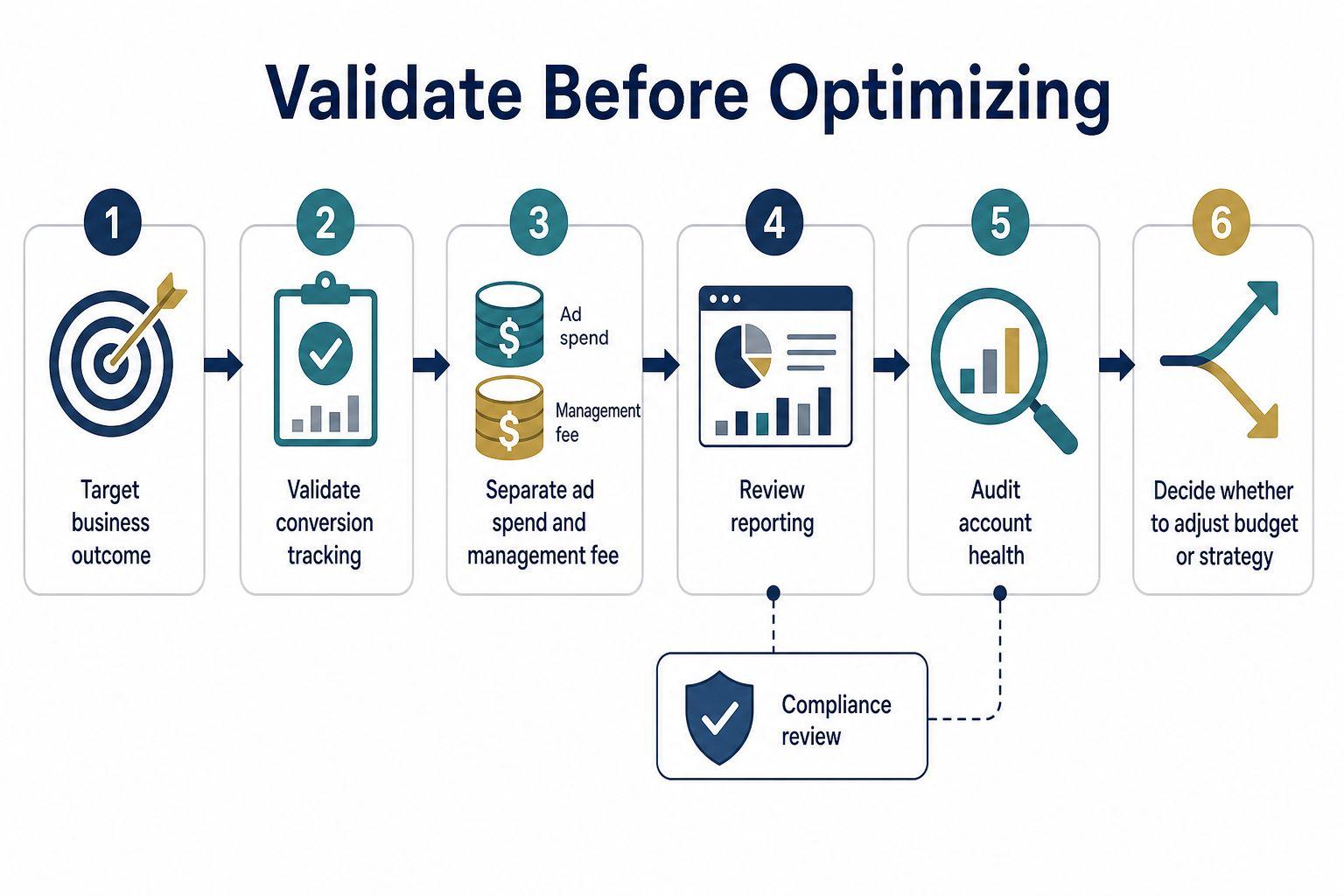
A defensible package review follows a sequence, not a single end-of-month glance at a dashboard. The business outcome should be agreed first, since cost per acquisition or return on ad spend cannot be judged against a target that was never stated. Conversion tracking should then be validated before any performance number is treated as meaningful, because a broken or misconfigured conversion action invalidates everything measured against it.
Only after tracking is confirmed does the ad spend and management fee split get reviewed for proportion. Reporting contents come next, followed by a periodic performance audit covering quality score, click-through rate, and account structure. That audit should also define, explicitly, what evidence would trigger a change in budget or strategy, rather than leaving that decision to intuition after the fact.
Certain campaign categories carry operational compliance obligations that affect how this review runs:
- Housing,
- employment, and
- consumer-finance campaigns
in the U.S. and Canada require particular care, since Google restricts targeting based on attributes including:
- age,
- gender,
- parental status,
- marital status, and
- ZIP code
for these categories.
- A package operating in these areas should be reviewed for compliance with those restrictions specifically, alongside general data privacy handling for any personal information collected through conversion tracking.
What Should Be Requested Before Approving a PPC Package?
Every dimension covered so far converges on a single, immediate action: put a short written request in front of the provider before signing, covering economics, scope, measurement, control, and review terms in one document rather than five separate conversations.
That request does not need to be long. It needs to be specific enough that a vague answer becomes visible as a vague answer.
The request below is short enough to send today, as a follow-up to any proposal already in hand:
Please confirm, in writing: the exact split between ad spend and management fee; the specific conversion actions being tracked and who owns that data; the campaign management, keyword, and landing-page work included at this fee; the contents and frequency of monthly reporting; any compliance restrictions applicable to this account category; and the condition under which budget or strategy would be revisited.
Sending that request does not guarantee a stronger proposal comes back. It guarantees that whatever comes back can be compared on the terms that actually determine direct return, rather than on the number printed largest on the page.
About the Author