

A window and door company spent three months celebrating a 40 percent jump in form fills, only to discover at quarter close that closed revenue had fallen. The leads were real. Most were single-window quotes, storm-damage insurance shoppers, and renters forwarding photos for landlords who never signed anything.
Sales spent hours qualifying inquiries the marketing report already called wins. That gap between “more leads” and “more contracts” is the most common failure point in this category, and it is rarely caught until a sales manager compares booked estimates against actual signed jobs. By then, a quarter of ad spend is already gone.
The fix starts with a definition, not a channel.
Define the Full-House Replacement Outcome
A dependable pipeline for full-house window replacement is not a volume of inquiries. It is a predictable rate of qualified consultations that convert at a known ratio into signed contracts at a known average value.
Getting there requires the payer to fix five numbers before any agency conversation begins:
- The target contract value the business wants to sell against
- The appointment capacity the sales team can actually staff
- The historical close-rate baseline for full-house work specifically
- The serviceable demand in the areas being marketed
- The acquisition cost the margin can absorb per closed contract
Those five numbers turn a marketing relationship into something testable. Without them, every reporting conversation drifts toward the easiest number to inflate: lead count.
Contract value and close rate matter more than any single click metric, because a full-house replacement sale behaves differently from a single-pane repair. It carries a longer consideration window, a higher price anchor, and a buyer who is comparing quotes on trust as much as price.
A campaign that produces cheap leads but no shift in average contract value has not moved the business forward. It has moved the reporting dashboard forward.
Choose an Agency Against Revenue Criteria
Selecting a partner starts by testing whether the agency thinks in sales economics or in impressions and clicks. A firm that opens a pitch with cost-per-click benchmarks, without asking about close rate or average job size, is optimizing for a number the payer doesn’t spend against.
The evaluation should include a working relationship with a specialist window and door marketing agency that treats full-house replacement volume, not raw lead count, as the deliverable being sold.
Before signing anything, the buyer should confirm the agency can answer these directly:
- Discovery depth: does the agency ask about historical contract value, close rate, and crew capacity before proposing a media plan?
- Strategy customization: is the plan built around this business’s margin and capacity, or is it a template reused across every home-services client?
- Analytics access: will the agency connect ad platforms, call tracking, and CRM data into one reporting view, or will reporting stay siloed by channel?
- Shared definitions: are “qualified lead” and “booked estimate” defined in writing, with agreement from both sides on what disqualifies a lead?
- Scorecard cadence: how often are cost per lead, appointment rate, and closing ratio reviewed together, and who owns the report?
- Escalation path: what happens when appointment quality drops for two consecutive weeks, and who is accountable for the fix?
Set the Revenue Thresholds
Thresholds should be written down before the first campaign launches: minimum qualified lead volume, minimum appointment rate, and a target customer acquisition cost calculated against average contract value rather than against lead cost alone. A campaign producing leads at a low cost per lead but a poor appointment rate is not cheap. It is expensive labor spent qualifying dead inquiries.
Inspect the Accountability System
Accountability means someone owns the number when it goes wrong, not just when it goes right. An agency that presents only lead totals, without appointment or closing data layered in, has not built an accountability system. It has built a highlight reel.
Match Channels to Replacement Intent
Channel selection should follow the buyer’s stage in the decision, not a generic media mix. A full-house replacement prospect researching materials and installers behaves differently from one comparing quotes after a first consultation, and the marketing plan should treat those as separate jobs.
Local SEO earns attention from active research, the homeowner reading about materials and installers before they are ready to talk to anyone, and it is measured by organic consultation requests by service area. It carries the energy-efficiency and remodeling-credibility story that this buyer wants to see before making contact.
Paid search and local service ads reach the buyer who is ready to request a quote now, and the number that matters there is cost per qualified appointment, not cost per click. Fast response and clear licensed-and-insured signals do the work in this stage, because speed itself is a trust signal.
Retargeting holds attention through the weeks when a prospect is comparing quotes but has not decided, and it is measured by how many of those return visits turn into booked calls. Referral and review reinforcement close the loop at the late stage, when a prospect wants one more confidence check before signing, and the signal to watch is referral-sourced consultations booked.
No channel above guarantees a contract on its own. Local SEO and paid channels bring attention; retargeting and reviews build the trust that a five-figure remodeling decision requires before a signature happens. The channel mix is chosen for its contribution to qualified consultations, not for its ability to look busy on a dashboard.
Build the Campaign Around Contract Economics
Before the agency writes a single ad, the payer hands over the inputs that keep messaging tied to margin: offer boundaries, which product lines and financing terms the business will actually sell, full-house replacement priorities over single-unit repairs, differentiators grounded in verifiable proof such as warranty terms or completed project photos, current consultation availability, and recent sales feedback on what objections keep surfacing in the field.
That feedback loop matters because messaging built without it tends to attract the wrong buyer.
A campaign promising the lowest price draws price shoppers who churn through consultations without signing. A campaign built around energy-efficiency upgrades and full-project scope, with proof assets to back it, tends to draw buyers already sized for the ticket the business wants to close.
Competitor review can sharpen that positioning, but only on the basis of what is visible in search results and public messaging, not on assumed pricing or capacity elsewhere. Once messaging is set, the promise it makes has to survive contact with the landing page and the person who answers the phone.
Connect Lead Capture to Booked Estimates
A campaign that generates interest and then loses it at handoff has not built a pipeline. It has built a leak.
The sequence from first click to closed contract needs to be visible end to end:
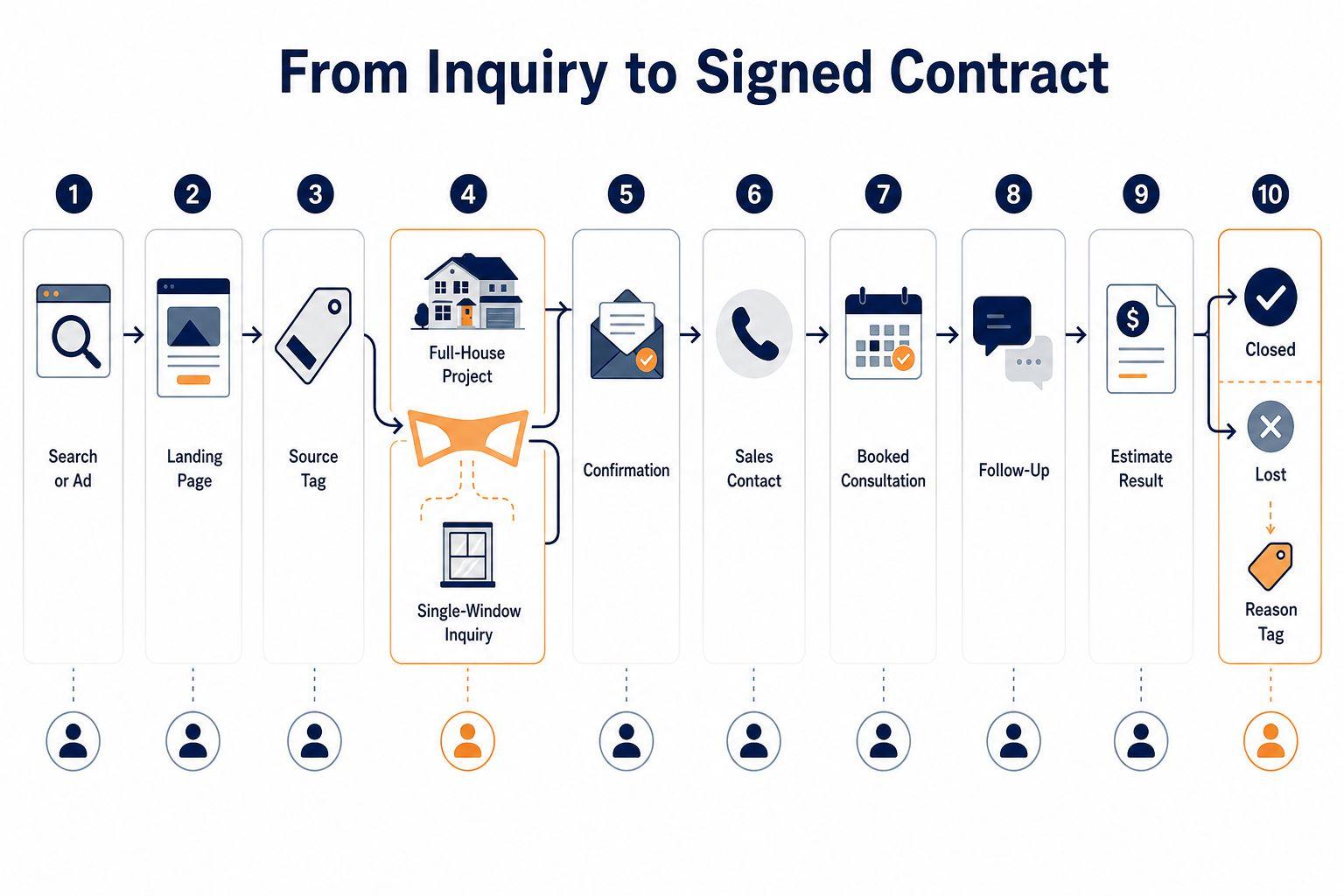
- search or ad response
- a conversion point on the landing page
- source capture that tags where the inquiry came from
- a qualification step
- immediate confirmation to the prospect
- a sales contact
- a booked consultation
- a follow-up cadence
- an estimate outcome
- and finally a closed or lost contract
Each handoff in that chain needs an owner and a rule. Who owns response time once a lead lands, and what is the maximum acceptable delay? How is lead status labeled as it moves from new to qualified to appointment to sale, and who updates that status? What does a sales rep record after every call, and does that disposition feed back into the marketing report?
Define the Qualification Gate
A qualification gate separates full-house prospects from single-item inquiries, renters from homeowners, and window shoppers from buyers with a project timeline.
Some published guidance for window and door lead generation recommends layering earlier qualification into automation and paid targeting itself, filtering out poor-fit inquiries before a sales rep spends time on the phone. Used as one operating tactic among several, that kind of earlier filtering reduces wasted appointment slots without pretending to remove the need for a human qualification step.
Close the Follow-Up Loop
Some published guidance for installer lead generation describes a fast-response sequence: automated confirmation, a brochure or portfolio sent by email, a sales call attempted within minutes of the inquiry, and a structured follow-up sequence over the following week. Treated as an operating example rather than a universal guarantee, that pattern illustrates why response speed and structured follow-up matter more than any single ad’s click-through rate.
Retargeting has a role in this loop too. A remodeling-industry source notes that retargeting can keep a brand visible during a multi-week consideration window, which matters because a full-house replacement decision is rarely made on the first call.
The follow-up loop closes when every lead has a final status: booked, estimated, closed, or lost, with a reason attached.
Review the Scorecard Before Renewing Spend
Before adding budget to fix a slow quarter, the numbers need to be read together, not separately. A rising lead count with a falling closing ratio is not the same problem as a falling lead count with a stable closing ratio, and each calls for a different fix.
The scorecard that answers this pulls cost per lead, lead-to-appointment conversion rate, appointment-to-sale closing ratio, customer acquisition cost, average contract value, return on ad spend, and channel-level revenue contribution into one review, read side by side rather than in isolation.
If volume rises while appointment quality falls, the problem sits in targeting or qualification, not in sales performance. If booked estimates rise while the closing ratio drops, the problem sits in sales follow-up or offer fit, not in the media plan. Chasing more budget before separating those two failure modes is how seasonal slumps get mistaken for market saturation, when the real issue was a qualification gate that stopped working two months earlier without anyone noticing.
Set Communication Rules That Prevent Drift
Alignment erodes fastest in the weeks after a campaign launches well, because early wins reduce the urgency of the review cadence that caught early problems. A small set of standing rules prevents that drift without turning the relationship into a meeting calendar.
A shared dashboard, updated on a fixed schedule, keeps cost per lead, appointment rate, and closing ratio visible to both sides without requiring a special report. A regular review, weekly early on and monthly once the pipeline is stable, keeps the agency and sales team looking at the same numbers.
Missed appointments need an agreed response rather than a shrug. Campaign changes need documentation, so a dip in performance can be traced to a specific decision rather than guessed at. Objections raised in consultations, and reasons a deal went closed lost, need to travel back to the agency, because that feedback is what keeps messaging tied to what buyers actually say in the room.
None of this is about running more meetings. It is about making sure the report on the screen tracks pipeline stages and contract value, not clicks and lead totals sitting alone.
Start the First Forty-Eight Hours With Evidence
The same stream of inquiries that once looked like a win, and turned out to be a leak, is exactly the evidence needed to sort before spending another dollar on expansion. Nothing here requires a new campaign to start. It requires a look backward before any conversation moves forward.
- Pull the last two to three months of lead, appointment, and sale records first. Everything after this depends on knowing the actual baseline, cost per lead against closing ratio, rather than the version of it in last quarter’s report.
- Write down the full-house replacement outcome and its thresholds next. Target contract value, appointment capacity, close-rate baseline, and acceptable acquisition cost, so any agency pitch can be tested against real numbers rather than promises.
- Ask any prospective or current agency for its proposed measurement and handoff design in writing. This has to happen before spend changes hands, not after a disappointing quarter, because accountability agreed after the fact is not accountability.
- Put the first scorecard review on the calendar before the campaign launches. A review date with no fixed session on the calendar tends to slip until the next disappointing report forces it.
None of this promises a specific result. It builds the shared, revenue-linked record that makes the next conversation about spend a conversation about evidence, not about hope.
About the Author