

The largest SEO package on the price sheet is usually the least scalable option in the room. That sounds backward until the mechanics are laid out: a bigger bundle of tasks does not extend automatically when a business opens a second location, adds a service area, or launches a new product line. It just gets more expensive to run in place.
Scalability is a property of how work is structured, not how much work is listed.
A twelve-line scope with a documented expansion process for new markets will outlast a forty-line scope with no such process, because the second one has to be renegotiated, city by city, the moment the business grows.
That distinction is the one an evaluator has to defend to whoever signs the invoice. It cannot rest on a package name.
Define Scalable SEO in Operating Terms
A package is scalable when its strategy extends across new footprint, service areas, content volume, and technical surface area without a rebuild, and when reporting keeps pace with that extension instead of lagging behind it. Deliverables are the tasks performed. Outcomes are what those tasks produce in rankings, traffic, and eventually revenue. A scope document can list fifty deliverables and still fail to scale if none of them describe what happens when the business adds a fourth city.
Most vendors present seo packages as fixed tiers distinguished by task count. That framing hides the more useful question: which tier has a documented path for adding scope without starting over.
A 2026 guide on prioritization built around the Pareto Principle notes that roughly 20% of pages, keywords, and optimization tasks tend to generate the majority of organic traffic and leads. That is a reasonable argument for choosing a package that concentrates effort on the highest-value pages first, rather than one that spreads thin activity across everything at once.
Four questions separate a genuinely scalable scope from a generic one:
- Scope clarity: is every deliverable named specifically enough to be checked off, rather than described in adjectives?
- Capacity headroom: does the scope state what happens to hours, content volume, or technical work when the business adds a location or product line?
- Measurement continuity: does the reporting structure carry forward unchanged as new markets are added, or does it need to be rebuilt each time?
- Expansion process: is there a written procedure for onboarding a new market, or is expansion handled as an ad hoc renegotiation?
A package that fails the fourth question will eventually fail the first three as well, because undocumented expansion tends to arrive as scope creep rather than planned capacity.
Match Package Architecture to Business Footprint
Package labels such as local, ecommerce, enterprise, one-time, and ongoing describe a starting orientation, not a guarantee of fit. A local package built for a single-location service business will not absorb a fifty-SKU product catalog without changing its measurement approach, and an enterprise package sized for a thousand-page site will over-deliver, at cost, to a business with four locations and a stable service list.
The useful comparison is not which label sounds most serious. It is which operating trigger the business actually faces, and what proof should exist before that model is selected.
| Package Model | Operating Trigger | Proof Required Before Selection |
|---|---|---|
| Local | Single or multi-location service area growth | Evidence of a repeatable location-onboarding process |
| Ecommerce | Growing or changing product catalog | Documented handling of catalog churn and out-of-stock pages |
| Enterprise | Large site, multiple business units, or brand architecture | Case evidence of prior technical audits at comparable scale |
| One-time | A defined project such as a migration or audit | Written scope boundary and handoff plan |
| Ongoing | Continuous content, technical, and authority work | Sample report showing month-over-month baseline tracking |
Location-based intent changes the picture first. A business adding service areas needs a package where local content and citation work can be replicated at a known cost per location, not one where every new city requires a fresh proposal.
Catalog complexity works similarly on the ecommerce side. A ten-product catalog and a ten-thousand-SKU catalog cannot run on the same template logic, and a package that has not addressed templated product pages at scale will struggle once inventory turnover accelerates.
Site scale and technical debt push toward the enterprise model, but only when the business can produce evidence, not assurance, that the vendor has handled comparable technical complexity before. Maintenance cadence is what separates one-time from ongoing: a migration or audit has a natural end point, while ranking and traffic maintenance does not.
Verify the Delivery System Behind Growth
A scope of work is only as credible as the ability to inspect it. Any package can promise technical audits, local optimization, and content authority building. Fewer can show the artifact that proves each workstream happened, who owned it, and which standard it was measured against. That inspection is what separates a scalable operating system from an activity list dressed up as one.
Confirm Technical Foundations Are Documented
Technical SEO audits and remediation should be traceable to a specific crawl, a prioritized issue list, and a remediation log. The acceptance evidence is a before-and-after crawl comparison, not a narrative summary. The relevant standard here is Google’s own webmaster guidance on crawlability and indexing, which sets the baseline for what “technically sound” is supposed to mean, alongside general industry practice for site health monitoring.
Confirm Local Operations Have an Owner
Google Business Profile optimization, citation management, and service-area or location pages need a named process, not a one-time setup. Acceptance evidence includes a citation audit log, a profile update history, and dated location page publication records.
Local content, where it exists, should map to a specific service area rather than duplicating the same template with a city name swapped in, which industry best practice treats as a quality risk rather than a scale advantage.
Confirm Content and Authority Work Has Criteria
Content planning, on-page optimization, and earned-link practices should each have defined acceptance evidence: a content brief and publication calendar, an on-page checklist tied to search intent, and a link-outreach log showing method and outcome, not just a count. Distinguishing included work from add-ons matters here specifically, since content volume and link-building intensity are the two areas most often reduced without notice when a package is priced below its actual scope.
Test the Location-Addition Workflow
Growth without a rebuild depends on a workflow that has already been written down and used, not a claim of flexibility made during a sales call. The clearest way to test this is to ask what happens, concretely, when a business adds one new location or service radius, and to request the artifact produced at each phase.
A defensible expansion workflow moves through five checkable phases:
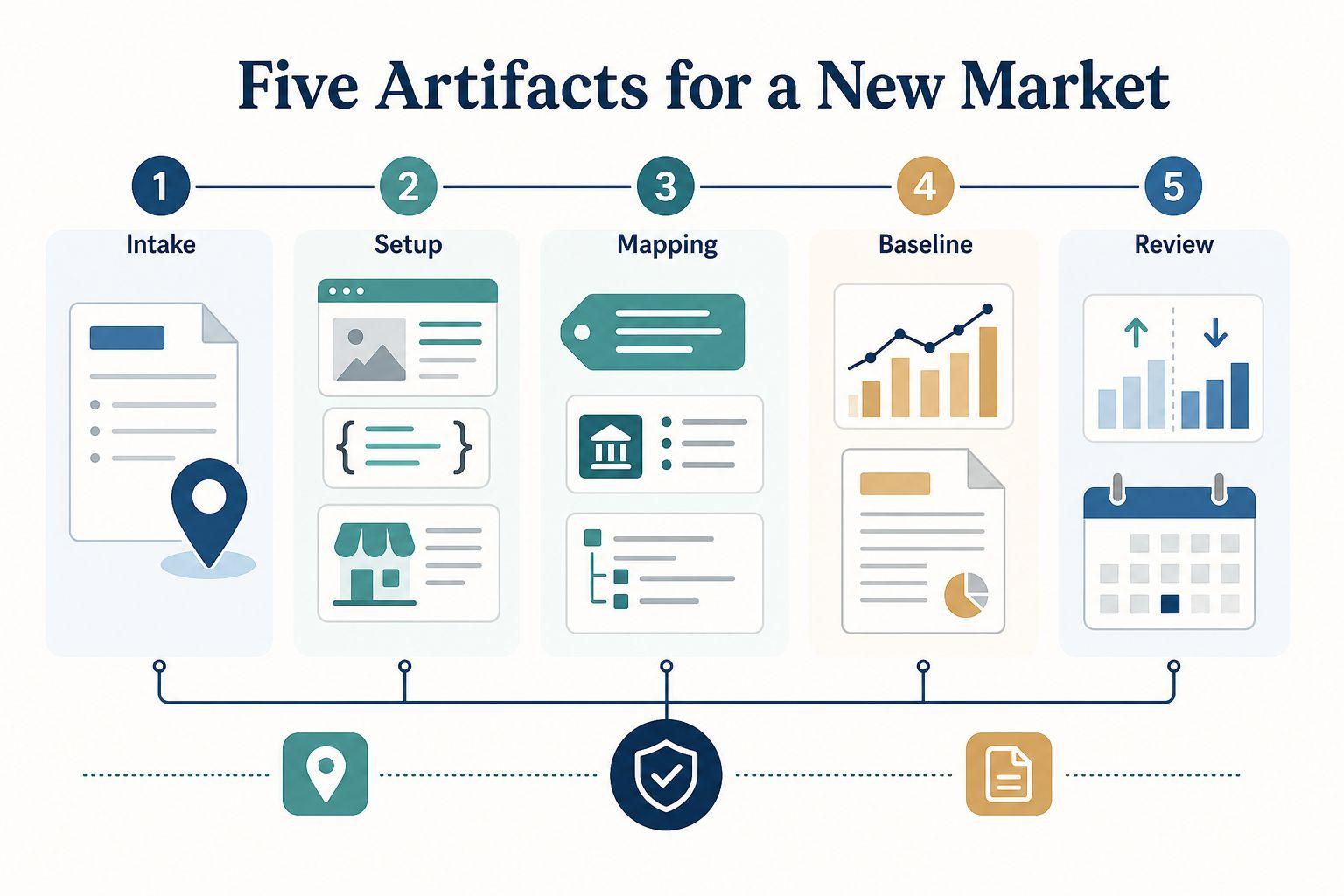
- Intake: the vendor documents the new market, competitive context, and service radius; the artifact is a written market brief.
- Technical and profile setup: location pages, schema, and a Google Business Profile listing are created; the artifact is a published-page URL and profile listing confirmation.
- Intent and citation work: local keyword mapping and citation building are completed for the new area; the artifact is a citation log and content outline.
- Baseline measurement: rankings and traffic for the new location are recorded before optimization compounds; the artifact is a dated baseline report.
- Review: performance against the baseline is checked on a fixed schedule; the artifact is a comparison report with a stated review date.
What changes with each added location is the local content, citation footprint, and profile setup. What should remain governed centrally is the technical framework, the reporting template, and the measurement method, so that a tenth location is evaluated the same way as the first.
Connect Reporting to Commercial Evidence
Visibility is not the same thing as demand, and a report that only shows rankings is a partial report. Organic keyword rankings, organic traffic, and organic traffic growth rate function as leading indicators: they show whether visibility is moving in the right direction.
Conversion rate, qualified local demand or leads, and return on investment are business indicators, and they answer the question a leading indicator cannot, which is whether that visibility is translating into anything the business can bank.
A sample report worth accepting shows a documented baseline, not just a current snapshot, since improvement is meaningless without a starting point. It segments results by the dimension that matters for the business, location, service area, or site section, rather than reporting a single blended number that hides underperformance in one market behind strong performance in another. It annotates the dates when scope or strategy changed, so a traffic dip or spike can be attributed to a cause instead of guessed at.
Reporting has to change shape as footprint expands. A single-location report and a twelve-location report cannot use the same template if the twelve-location version simply averages everything together. No package, regardless of tier, should promise a specific ranking position, a traffic figure, or a revenue outcome, since none of those results are within a vendor’s direct control.
Price Scope Before Comparing Monthly Fees
Comparing a $1,200 monthly fee to a $6,000 monthly fee without normalizing scope produces a false comparison, because the two proposals are rarely describing the same volume of work.
A 2026 breakdown of SEO pricing for growing businesses places starter packages in the $500 to $1,500 per month range, growth packages between $1,500 and $5,000, and enterprise bundles from $5,000 to $10,000 or more, with the higher tiers typically adding items like dedicated strategists, migration support, and log-file analysis. Those figures are context, not a benchmark to be matched.
What changes the real cost is:
- service tier
- customization
- resource allocation
- automation
- market size
- service radius
- site complexity
- and the size of the business footprint being covered.
| one | while the other |
|---|---|
| includes automated reporting and templated content | includes manual technical review and custom local content for each market. |
Two packages priced identically can differ sharply once.
Before comparing fees, request:
- An included and excluded deliverables schedule
- The specific pricing logic for adding a location
- The assumptions the price is built on
- The change-control terms for scope adjustments mid-contract
- The method used to measure return on investment
Published price ranges are a starting reference, never a promise, and never a substitute for a scope comparison built on the business’s own footprint.
Check Vendor Accountability and Asset Control
Scalable-looking work can still fail without warning when access and support are opaque, and that failure often shows up only after the contract is signed and a location has already been added.
Verifiable answers should exist, before signing, on reporting cadence, the escalation path when something breaks, who approves content and technical changes, and who has direct access to analytics and search console platforms.
Ownership of content, optimization assets, and documentation should sit with the business, not be held by the vendor as a bargaining chip against cancellation, and continuity terms should state what happens to the work if scope changes or the contract ends.
Automated reports with no analyst commentary, unexplained proprietary terminology, deliverables described only in adjectives, and any guarantee of specific rankings are not signs of sophistication. They are comparison failures, and each one should be treated as a reason to ask a sharper follow-up question rather than a reason to move on.
Send a Scope-Comparison Request Today
Everything above resolves into one action: before selecting a tier, request comparable evidence from every shortlisted provider, in writing, using the same questions for each. A tier chosen on price or package name alone cannot be defended later; a tier chosen against documented scope, workflow, and measurement can.
That request does not need to be long. It needs to force a specific, checkable answer instead of a general reassurance, and it needs to arrive before a contract is signed, not after growth exposes the gaps in scope.
Please provide, in writing: (1) an included and excluded deliverables schedule for the proposed package; (2) the documented workflow and incremental cost for adding one new location or service area; (3) a sample report showing organic keyword rankings and organic traffic connected to conversion outcomes; (4) written confirmation of who owns content, optimization assets, and platform access after the engagement; (5) the assumptions behind the proposed scope and ROI measurement method.
Send that request to every provider on the shortlist before ranking them, and score the responses against each other rather than against the sales pitch each one already made.
About the Author