

More traffic to a home improvement website is often a warning sign, not a win. A campaign that lifts visits by forty percent while lead volume stays flat has not found new customers. It has found new visitors who were never going to call.
That gap between visits and inquiries is where most contractor marketing budgets go silent. The dashboards look healthy. The phone does not ring any more often than it did before.
The rest of this depends on treating that distinction as the starting filter for every decision that follows, not as a footnote to revisit later.
Define Search Engine Optimization by Lead Intent
Search engine optimization for a home improvement company is not a project that ends when rankings improve.
It is an operating system with several dependent parts:
- how the business shows up in: Google Search – local results
- what a visitor finds on the service page they land on
- what reputation signals they see before deciding to trust the company
- what happens in the ten seconds after they decide to act
Any one of those parts can fail while the others look fine.
The distinction that matters is between raw visits and qualified contact, meaning a phone call or a form submission from someone with a real project and a real budget. A roofing company can rank for “roof types explained” and pull steady traffic from people doing research three years before they buy anything. That traffic is not worthless, but it is not the traffic a business depending on next month’s job pipeline can afford to optimize for first.
A multi-channel approach, meaning local presence, service pages, and reputation working together rather than in isolation, exists to close that gap. The channels are not competing tactics. They are dependent stages, and skepticism about which one deserves attention first is the correct starting posture.
Repair the Website Before Expanding Search Demand
Sending more search traffic to a website that cannot convert it is the most common way contractor SEO budgets get wasted. Before any keyword expansion or local visibility work begins, the site itself has to be checked against a narrower question: if a qualified visitor lands here right now, can they act in under a minute? For most contractor sites, the honest answer is no, and the reasons are consistent enough to check in order.
Fix the Technical Foundation First
Mobile speed, crawlability, clean on-page structure, and schema markup are not advanced refinements. They are the baseline that determines whether a service page gets found at all.
A service page that takes six seconds to load on mobile has already lost a meaningful share of visitors before a single word registers, and no amount of content quality recovers that visitor once they have left. This is the layer where dedicated seo for home improvement companies work earns its cost, because technical repair rarely shows up in a screenshot but shows up immediately in bounce data.
Remove Friction From the Conversion Path
Once the technical layer is sound, the second question is whether the page actually asks for the job. Contact paths buried below three scrolls, forms that ask for information a phone call would settle in ten seconds, and generic testimonials with no project specifics all add friction at the exact moment intent is highest.
The implementation checks, in the order they should be done:
- Confirm mobile load speed and fix the worst-offending pages first, since these lose visitors before content is even read.
- Verify crawlability on every page, and check that schema markup correctly describes the service and service area.
- Audit on-page structure so headings and page titles match what a searcher actually typed.
- Move phone numbers and a short contact form above the fold on every service page.
- Replace generic testimonials with project-specific proof tied to the service being offered.
Skipping this repair to chase new keyword rankings is a common and expensive mistake, because it multiplies the traffic hitting a page that was already failing to convert.
Map Keyword Research to Services and Service Areas
- Keyword research for a contractor business is not a list of city names bolted onto service names. It is a sequence, and skipping a step produces pages that rank for nothing specific and convert nobody.
- The first step is identifying actual demand at the intersection of a service and a location, not assuming that “roofing plus city name” is automatically what people search. The second step is classifying those terms by intent: someone searching “emergency roof leak repair” is closer to calling today than someone searching “roof replacement cost guide.”
- A 2026 SEO checklist recommends evaluating qualified keywords for search intent and then grouping three to five related keywords around each vetted term, rather than building a page around a single phrase in isolation. That grouping is the third step. It matters because a page built to answer one narrow phrase tends to ignore the two or three adjacent questions the same visitor is actually asking.
- The fourth step, and the one most often skipped, is assigning each keyword group to a distinct service-area page rather than duplicating one template across ten cities with the city name swapped. A page has to answer a specific service-and-place need: walk-in shower installation in a particular service area, storm damage roof repair in another, not simply a location repeated under a different heading. Pages that only vary by city name tend to compete with each other rather than for anyone’s business.
Build Local SEO Signals That Support Google My Business
Local seo is the verification layer. It exists to confirm, in ways Google and prospective customers can both check, that the company is real, operates where it claims to operate, and has done work people were satisfied with. Everything in this layer either strengthens or weakens that verification, which is why it deserves treatment as a system rather than a single profile to fill out once.
The starting point is a complete and current Google My Business listing: accurate service categories, correct service-area boundaries, current hours, and photos that reflect actual completed work rather than stock imagery. An incomplete profile does not just look unfinished, it gives Google less to verify against everything else the business claims.
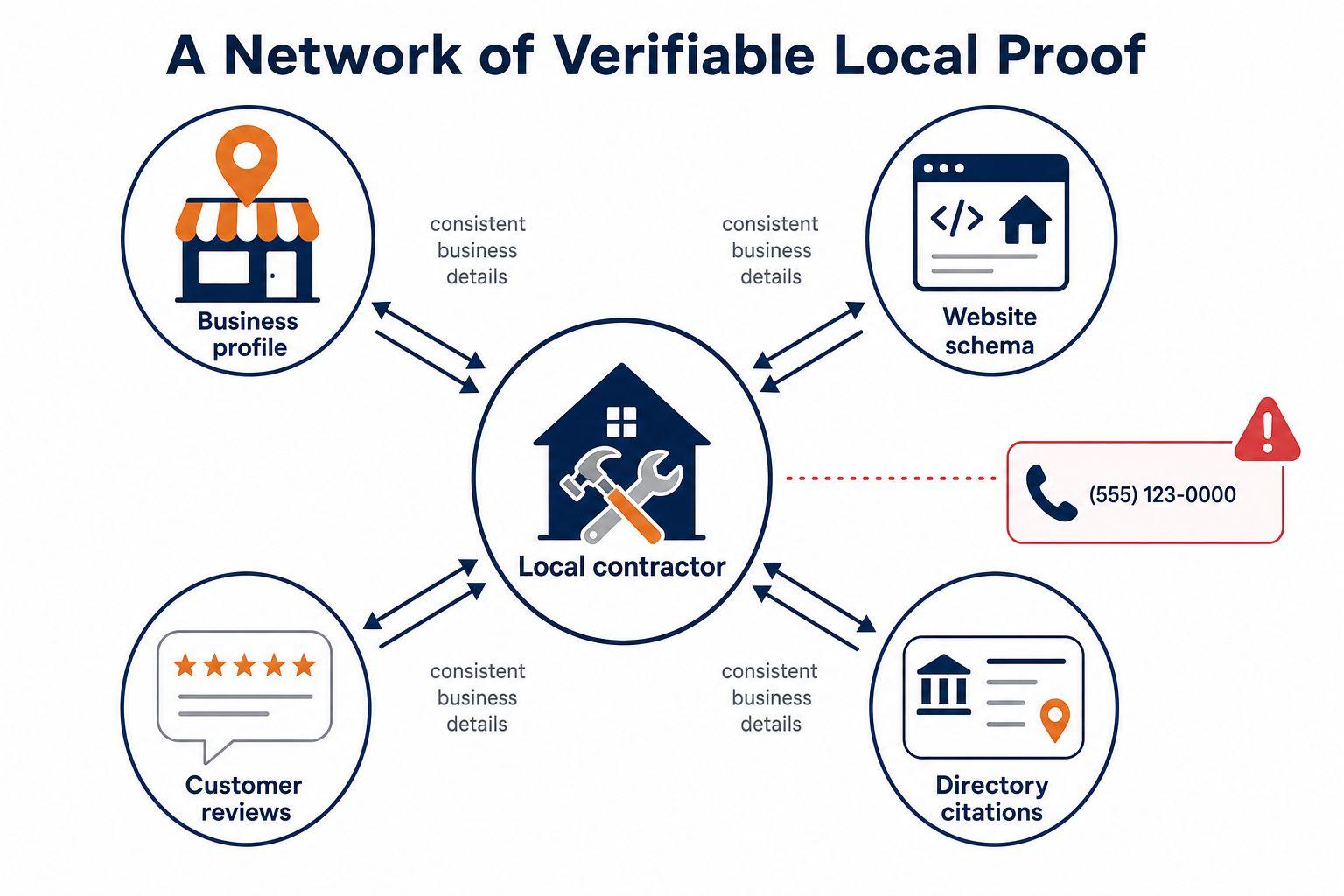
A profile alone is a claim. Schema markup, customer reviews, and citations are the independent evidence that backs the claim up. A 2026 home-improvement SEO guide notes that citation building on directories such as Yelp, Angi, and local chamber of commerce sites helps Google verify a business’s location and legitimacy, precisely because those listings exist outside the company’s own control and therefore carry more weight as confirmation.
| Local Signal | Verification Purpose | Operational Evidence Needed |
|---|---|---|
| Google My Business profile | Confirms core business facts to Google and searchers | Accurate categories, hours, service area, and current photos |
| Schema markup | Structures service and location data for machine reading | Correct service and area tags matching the actual page content |
| Customer reviews | Demonstrates completed work and satisfaction over time | Ongoing review requests tied to finished jobs, not one-time pushes |
| Directory citations (Yelp, Angi, chamber sites) | Cross-verifies location and legitimacy from outside sources | Consistent business name, address, and phone across every listing |
Inconsistency across these signals does more damage than a missing signal. A phone number that differs between the website and a directory listing gives Google a reason to doubt rather than simply less to work with.
Publish Content That Extends Topical Authority
Supporting content earns its place only when it reinforces the service pages already carrying the business’s core intent, not when it becomes a calendar of loosely related blog posts published for their own sake. Project breakdowns, common-problem explainers, and process walkthroughs work because they answer the adjacent questions a service page cannot answer without becoming bloated, and because they link back to the page that actually converts.
A homeowner reading about how storm damage is assessed before a claim is filed is a different visitor than one reading a generic “signs you need a new roof” post with no connection to a specific service area. The first builds on the architecture already in place.
The second is filler that competes with the service pages for the same limited attention.
Paid advertising and other search channels have a role here too, but a supporting one: capturing demand quickly while organic authority builds, not replacing the foundation underneath. Questions about AI Overview placement, Answer Engine Optimization, and whether ChatGPT can perform SEO work are worth tracking as they surface in search behavior. None of them currently have a settled, evidence-backed answer, and treating them as solved would be a mistake this early.
Earn Authority Through Links and Customer Reviews
Authority for a local contractor builds in a specific order, and reversing the order rarely works. It starts with completed work worth talking about, because no amount of review requests or outreach compensates for a project that did not go well.
From there, requesting reviews from real customers, and displaying them prominently rather than burying them on a separate page, turns finished work into visible proof for the next prospect doing research. Locally useful proof assets, a before-and-after gallery tied to a specific neighborhood project, a short explanation of a permit process specific to the service area, extend that proof beyond star ratings alone.
Link building and customer reviews solve different problems and neither substitutes for the other. Reviews demonstrate satisfaction directly to prospective customers browsing a listing. Link building, pursued through legitimate local relationships, supplier partnerships, trade association pages, local news coverage of completed projects, signals to Google that other credible sites vouch for the business. Chasing either one without the completed work behind it produces a request that has nothing to point to.
Measure Leads Before Declaring SEO Successful
Ranking improvements and traffic growth are visible early and mean little on their own. The chain that actually matters runs from organic discovery, to engagement on the page a visitor lands on, to a form submission or phone call at the end. Skipping straight to the last link in that chain, checking lead counts without knowing which pages produced them, makes it hard to know what to fix when volume slows.
A 2026 home-improvement SEO guide points out that Google Analytics can show how many visitors arrive through organic search, which pages perform best, how long visitors stay, and whether that traffic actually converts into leads through forms or calls. That combination, not any single metric, is what separates a page that is working from one that only looks busy.
Google Search page-performance data adds a prioritization layer on top of that. A separate 2026 SEO guide frames the familiar 80/20 pattern as a prioritization method rather than a fixed formula.
It recommends reviewing the last twelve months of Search Console data to find the small set of pages responsible for most clicks. Questions about the “3 C’s of SEO” or whether search optimization is worth its ongoing cost surface often in searches about this topic, but neither has a fixed answer here worth repeating as fact.
Complete the First Forty-Eight Hours of Execution
None of the preceding steps mean anything without a starting point to measure against, which is why the first move is not a fix at all.
- Record the current baseline for organic leads and page-level engagement in Google Analytics, because every later decision needs a “before” to compare against, and that baseline degrades the longer it waits.
- Audit the highest-intent service page and the Google My Business profile together, since a mismatch between what the page promises and what the profile confirms is the fastest thing to catch and fix.
- Select one service-area keyword cluster to implement against, rather than starting several at once, because a single focused implementation can be measured cleanly against the baseline already recorded.
The order matters because measurement without a baseline produces numbers nobody can interpret, and implementation without an audit risks building on a page that was already broken. The one thing worth doing before anything else on this list: open Google Analytics today and write down the current organic lead count for the past thirty days. Every decision that follows gets measured against that number.
About the Author