
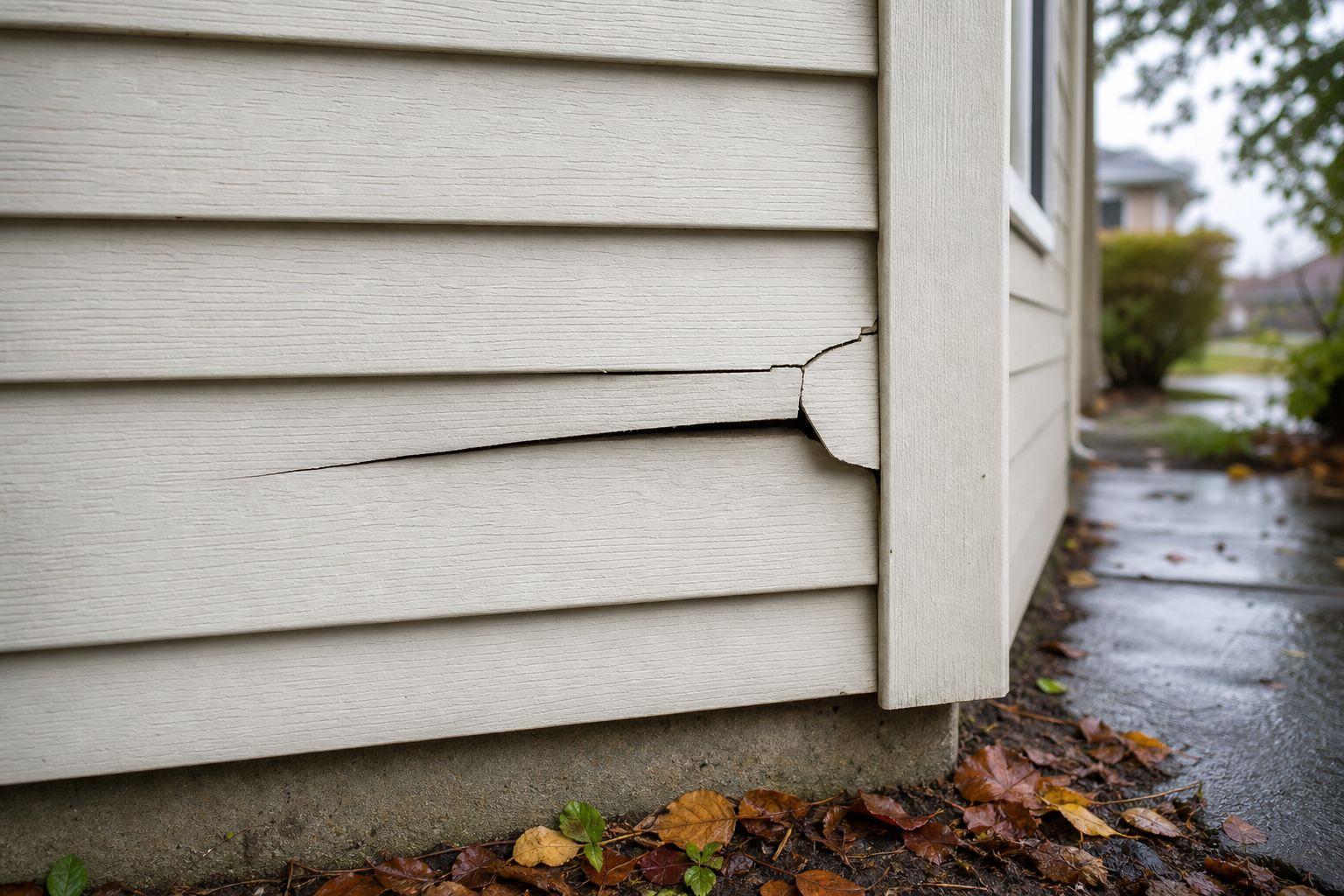
What does a homeowner standing in their yard, looking at a cracked panel after last night’s wind, actually type into a search bar?:
- Does anyone at the siding company ever see that exact phrase before deciding what the website should say?
Most siding repair businesses never answer that question directly. They answer a different one instead: how do we get more visitors to the site. Those are not the same problem, and the gap between them is where estimate requests silently disappear.
A homeowner with a damaged panel is not browsing. They are triaging.
That distinction changes everything about what a repair-focused site, profile, and inquiry path need to do.
Why Does Siding Repair Need a Different Local Search Plan?
Siding repair is not a subset of “home remodeling” in the searcher’s head, even though contractors often file it there internally. A remodeling search and a repair search come from two different emotional states. One person is planning a look for next spring. The other has water getting behind a wall panel right now. Treating both as the same audience, reachable through the same generic service page, is the first place inquiry volume gets lost.
Urgent damage looks different from planned renovation intent, and the difference shows up in the words homeowners choose. Someone dealing with a storm-cracked section, a warped board, or pest damage around a joint is searching to solve a problem today or this week. Someone considering a full re-side for curb appeal is comparing materials, colors, and contractors over weeks or months.
A site built only for the second group buries the first group under gallery pages and material comparisons when what they wanted was a phone number and a same-week estimate.
Material-specific concerns add another layer. A homeowner with damaged fiber cement wants to know that the person answering the phone has actually worked with that material, not just vinyl. Someone with storm damage after a documented weather event wants reassurance that the repair crew has handled that kind of damage before, not a general remodeling pitch.
The useful goal is narrower than most site audits assume. It is not visibility in the abstract. It is a qualified call or estimate form from a homeowner whose address sits inside a service area the business can actually staff and warranty. A lead from ninety minutes outside the service radius is not a smaller version of success. It is a different kind of failure, one that looks like traffic on a report and feels like nothing in the estimate calendar.
Why Does More Website Traffic Still Produce the Wrong Siding Leads?
Traffic reports flatter easily and mislead just as easily. A page can gain visits while the phone stays quiet, because the visits are coming from people who were never going to call, regardless of how the page ranks.
The operational question is not how many people land on a page. It is how many of them match three conditions at once: they have a repair need the business handles, they live inside a serviceable area, and they can find a way to act on the page without hunting for it.
| Visit Type | What They Are Searching | What They Need From the Page |
|---|---|---|
| Urgent repair intent | Damaged panel, storm impact, specific material fix | Scope match, service-area fit, visible phone number |
| Broad educational visit | “Siding types,” “cost to reside a house” | Comparison content, no immediate action expected |
| Out-of-radius visit | Same repair terms, wrong zip code | Nothing, the business cannot serve them |
| Price-only visit | “Cheapest siding repair near me” | Fast disqualification, not a sales pitch |
Optimizing for relevance and eligibility means accepting that some traffic should never convert, and building the page so it disqualifies that traffic without fanfare rather than chasing it. A rank report cannot tell the difference between these four rows. Only the page’s own structure, and its clarity about what the business actually does and where, can.
Which Local Siding Repair Searches Should Be Chosen First?
Choosing what to build for starts with a short, disciplined filter rather than an exhaustive keyword list. The filter has to answer one question for every candidate phrase: does this describe a repair job the business will actually take, in an area it will actually drive to?
A workable prioritization checklist looks like this:
- Local keyword research grounded in real jobs, not aspiration: pull the last dozen completed repair jobs and note the damage type, material, and neighborhood or zip code pattern that actually came through the door.
- One service, stated plainly: pick the single repair type generating the most calls today, whether that is storm-damaged panel replacement, rotted board repair, or seam and flashing fixes, and build the strongest page around that one.
- One legitimate service area, not a wish list: define the radius or named towns the crew can reach and estimate within a reasonable turnaround, and resist listing a city just because it has search volume.
- A careful read of search results for that phrase, without assuming what works in one market applies elsewhere: check what already ranks locally, note whether local businesses or national directories dominate, and avoid drawing conclusions about competitor behavior in a market never actually reviewed.
- Conditional inclusion of specialized terms: material names, insurance-claim assistance, certification mentions, and emergency-response language belong on the page only if the business genuinely offers and can document them. If the crew is not certified in a specific installer program, that phrase does not belong on the page, no matter how often homeowners search it.
That last condition matters more than it looks. A page that claims emergency response but cannot staff a same-day call loses the homeowner’s trust the moment the promise fails, and that loss is harder to recover than a missed ranking ever was.
How Should a Siding Repair Website Turn Search Intent Into an Inquiry?
A site earns an inquiry the same way a good technician earns a signature on an estimate: by being specific about the job, honest about the area, and easy to reach. That sequence has to show up in the page architecture itself, not just in a mission statement buried on an about page.
What Belongs on the Service Page
The center of the structure is a dedicated siding repair service page, separate from a general siding page and separate from full-replacement content. This page states the repair scope in plain terms: what kinds of damage get fixed, what materials are covered, and what a typical job looks like from first call to final walkthrough.
It names the service area directly, ideally with the specific towns or zip patterns the crew actually covers, so a homeowner outside that radius self-selects out before filling a form the office will just have to decline. It includes a visible phone number near the top of the page and an estimate request path that asks for exactly what the office needs to triage a job: address, damage type, and a photo if possible.
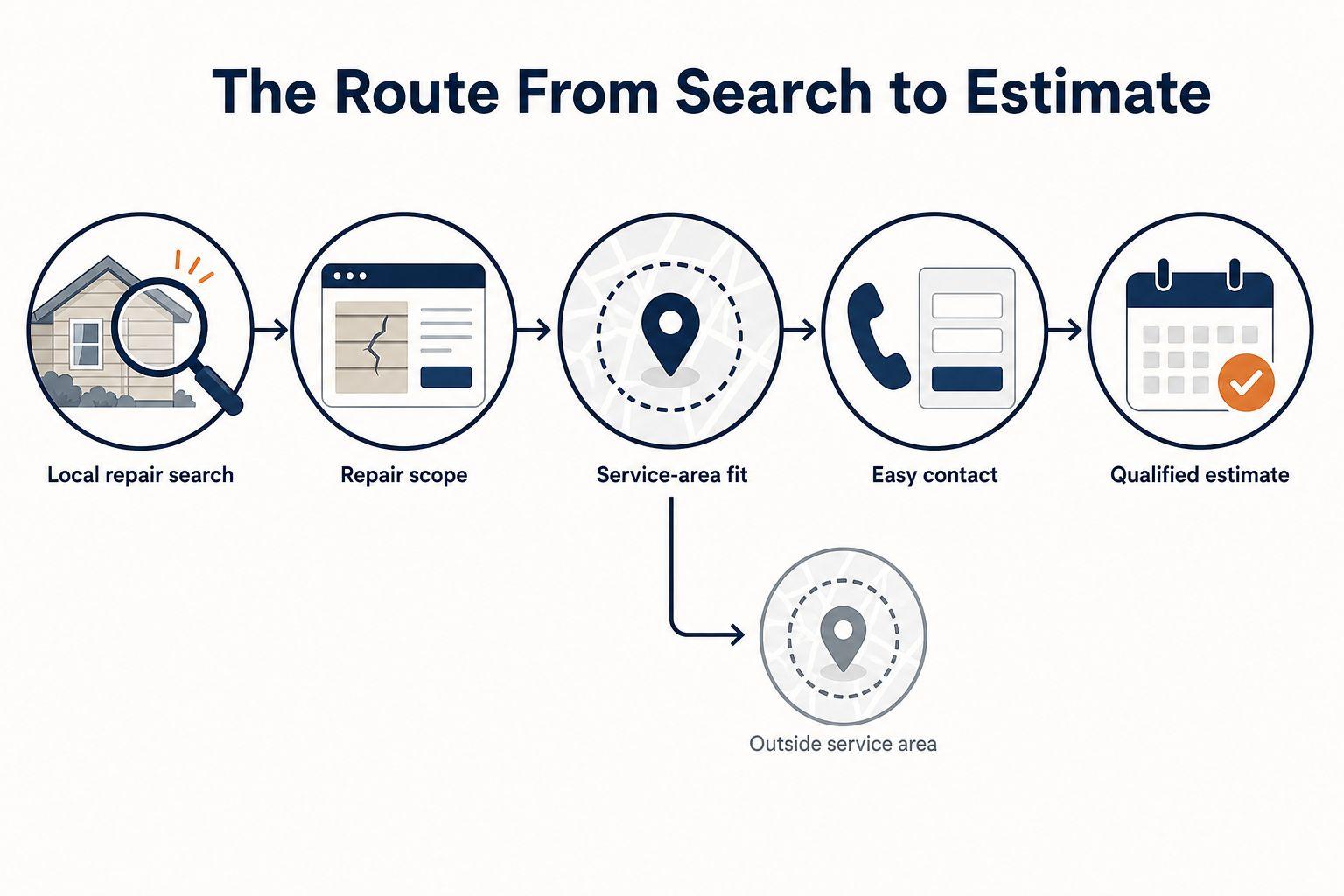
Location-aware pages, where they exist at all, need the same discipline. A page built for a specific service town only earns its place if the business has a real presence there: completed jobs, a reasonable drive time, and language specific to that area rather than a template with the city name swapped in. A thin page that only changes a place name while repeating identical copy does not help a homeowner decide anything, and it does not help the office either, since it invites inquiries the crew cannot fulfill.
Supporting content, like guidance on identifying storm damage or explaining common repair signs, belongs one layer below the service and location pages, not above them.
Its job is to inform someone who is not ready to call yet, and to route them toward the repair page once they are.
That separation keeps the site’s traffic honest: educational readers stay in an educational lane, and the repair page stays reserved for people ready to act.
None of this holds together without a site structure someone actually maintains on purpose rather than by accident. A short, practical framework for organizing exactly this kind of page hierarchy is laid out in a siding company seo guide built for repair-focused contractors, which is useful precisely because it treats the service page and the location page as different jobs with different rules, rather than variations of the same template.
The estimate form itself deserves one more piece of attention. Every extra field it asks for is a small tax on urgency. A homeowner with a damaged panel exposed to weather does not want to explain their renovation timeline. They want to describe the damage and get a callback.
How Can a Google Business Profile Match the Repair Work Being Sought?
Search and website structure only carry a homeowner halfway. For most local repair searches, the profile that shows up on Maps and in the local results panel is doing at least as much work as the website, sometimes more, because it is the first thing a phone-in-hand homeowner sees.
Google’s own business profile materials describe the purpose plainly: profiles help a business get discovered on Search and Maps, and details like hours and photos help nearby customers find and choose that business rather than a competitor several miles away. That framing matters here because it confirms the profile’s job is local matching, not general visibility.
Making the Categories and Services Match the Real Work
The categories, services, and details on the profile need to mirror the repair work actually offered, not a generic contractor listing. Google Business Profile’s service setup allows a business to add its category and then attach specific services within it, including a custom service entry when the exact repair type, such as storm-damaged siding panel replacement, is not offered as a preset option.
That custom-service capability is the direct mechanism for making a profile match a repair search rather than a broad remodeling one.
| Profile Element | Inquiry Signal It Supports | Practical Setup Note |
|---|---|---|
| Category and custom services | Matches the exact repair job being searched | Add a custom service entry for repair types not in the preset list |
| Service descriptions and pricing fields | Confirms scope before the call happens | Describe actual jobs taken, not aspirational services |
| Hours and phone number | Confirms the business can be reached now | Keep hours current, especially after seasonal changes |
| Photos and periodic updates | Shows real, recent repair work in context | Post job photos with visible damage type and repair result |
| Review responses | Signals the business engages with real customers | Respond to reviews that mention repair specifics, not just star ratings |
| Service-area settings | Prevents mismatched inquiries from outside the radius | Set the area to match what the crew can actually reach |
Google’s support documentation on service setup also notes that businesses can edit services and add price and description fields, which gives a repair contractor a direct way to separate “storm damage panel repair” from “full re-side” inside the same profile, so a searcher sees the specific service rather than a single undifferentiated listing.
The discipline required here is resisting the temptation to stuff every plausible keyword into the services list. A profile that claims twelve services the crew rarely performs reads as unfocused to both the algorithm and the homeowner scanning it on a phone screen. Accuracy is the feature, not a constraint on one.
What Proof Helps a Nearby Homeowner Trust a Repair Business Enough to Call?
Trust, for a homeowner about to let a stranger onto their roofline or exterior wall, is built from a small number of concrete things, not from a polished tagline. The proof has to be specific enough that a skeptical reader can verify it in thirty seconds.
A realistic proof-building list includes:
- Genuine review requests sent after every completed repair job, not just the large ones, so the review history reflects the everyday work the business actually does.
- Responses to reviews, especially ones that mention a specific repair type, since a thoughtful response shows the business reads and remembers its own jobs.
- Project photos with real context: the damage before, the repair after, and a short note on what caused it, rather than stock imagery.
- Before-and-after documentation specific to repairs, distinct from new-construction or full-replacement photos, since a homeowner comparing repair options wants to see repair outcomes.
- Locally relevant authority signals, built through modest, verifiable means: a mention in a local news item about storm damage, a listing in a community business directory, or a relationship with a local property manager who can vouch for the work.
Certifications, installer tier badges, specific material brand partnerships, insurance-claim assistance, and lead-paint disclosure language under EPA rules for pre-1978 homes all belong on the site only where the business genuinely holds them and can produce documentation on request.
A badge without substance behind it is a liability the moment a homeowner asks a follow-up question the office cannot answer.
How Should Storm Damage, Materials, and Permit Questions Be Handled Locally?
Permit rules, building codes, and even material handling requirements vary enough between jurisdictions that no repair business should publish a page implying a single rule applies everywhere it operates. A homeowner in Montréal researching siding repair permit rules is operating under a different set of local requirements than one in Oakland.
A business serving Manchester Township, Charlotte County, or Dallas would find at least as much variation among those five places alone.
The right response is not to avoid the topic.
It is to state clearly, on any page touching permits or code, that requirements depend on the specific municipality and that the office will confirm what applies before work begins.
The same caution applies to distinguishing typical repair scope from something larger. A homeowner asking about replacing a few damaged panels after a storm is often a straightforward repair call. A homeowner asking whether siding damage points to structural water intrusion or full wall-assembly failure needs a different conversation, potentially with a different professional entirely, and a repair page should say so rather than implying every inquiry fits the same job size.
Framing these topics this way protects both the homeowner and the business: it sets honest expectations before the estimate call, and it keeps the content from making a claim about code or permit process that will not hold up outside the one market it happened to be written for.
What Should Be Checked in the First Forty-Eight Hours?
None of this requires a rebuild. It requires an audit, done in a deliberate order, because each step depends on the one before it being right first.
- Hour one to hour four: review one priority siding repair page against the work actually accepted. Pick the single repair type generating the most real calls, then read that page as a homeowner would and ask whether it names the damage type, the service area, and a way to contact the business within the first screen. This comes first because a confusing repair page will waste every improvement made afterward.
- Day one, remainder: confirm the service area listed matches what the crew can genuinely reach and staff. Fix any location page or area claim that overreaches, since a mismatched service area creates leads the office will only have to decline later.
- Day one, evening or day two morning: check the Google Business Profile category, services, and hours against the same repair work. Add a custom service entry if the exact repair type is missing from the preset list, and update hours if they have not been touched recently. This step follows the website check because a profile that promises what the site does not, or vice versa, confuses the same homeowner twice.
- Day two: verify that a call from the website or profile, and a form submission, can both be traced to their source. Confirm the number on the site matches what is tracked, and test the estimate form personally to make sure it reaches someone who will respond same day.
Measurement comes last on purpose. A tracking setup layered onto a confusing page or a mismatched profile only produces clean data about a broken path. Fix what the homeowner sees and where they can reach the business first, then confirm the reporting behind it is actually catching what happens.
About the Author