

A resolved ticket is the worst possible moment to make an offer. That runs against the instinct of every revenue leader who has watched a support queue full of engaged, attentive enterprise accounts and wondered why nobody is capturing the moment.
The instinct is understandable. It is also the fastest way to damage the trust that made the account worth expanding in the first place. What follows is not a case against connecting support and revenue. It is a case for sequencing that connection so the evidence is real before anyone acts on it.
Define the Enterprise Outcome Before the Support Motion
Customer success, done properly, is the disciplined delivery and proof of outcomes across onboarding, adoption, retention, expansion, and advocacy. It is not a queue-clearing function, and its success metric is not how fast a case closes. An enterprise account can generate a fast, polite ticket resolution and still be drifting toward churn, because the underlying outcome, the reason the account bought in the first place, was never addressed.
Outcome Attainment Versus Ticket Closure
A closed ticket proves a symptom was handled. Outcome attainment proves the customer is getting what they paid for. Treating the two as equivalent is where most premature upsell attempts originate.
Where the Seven Pillars Fit
A 2026 customer-success framework describes the discipline as seven pillars: five sequential ones covering onboarding, adoption, retention, expansion, and advocacy, plus two that cut across all of them, operationalizing customer success and acting as a strategic advisor.
The same framework recommends building the operational pillar first, since it is the foundation the other five scale on. Without it, a support signal has nowhere reliable to land.
Separate Service Recovery From Expansion Evidence
Not every support case that mentions a limitation, a missing feature, or a workflow gap is an expansion opportunity. Some are urgent incidents that need containment, not conversation. Some are adoption friction that will resolve with better onboarding, not a bigger contract. A small number are a genuine signal that the account has outgrown its current scope. Confusing the three is how a support desk becomes a source of noise instead of intelligence.
The distinction matters because the wrong response at the wrong moment carries a cost that is hard to reverse:
- Urgent incident recovery: the customer is asking for stability, and any commercial framing reads as tone-deaf.
- Adoption friction: the customer needs training or configuration help, not a new line item.
- Future-fit growth signal: the customer describes a need the current plan cannot meet, observed consistently rather than in a single frustrated message.
A support case can reveal a need. It is not, by itself, an upsell event. Forcing an offer during recovery, working from stale account context, or routing a proposal to a contact who left the buying committee months ago will not just fail to close. It will confirm to the account that the vendor was never really paying attention.
Ask Which Accounts Merit a Later Value Conversation
If a ticket is not the trigger, what is? The honest answer is that no single signal qualifies an account on its own. What qualifies an account is a pattern, checked against verifiable context, not assumed from a support transcript.
Verifiable account context includes firmographic detail (industry, size, revenue band, location), behavioral data (product usage, feature adoption), intent signals (expansion questions, competitive mentions), and customer lifetime value. It also includes structural facts that are easy to assume and expensive to get wrong: the technology stack the account runs on, and who actually sits on the buying committee now. A signal without this context is a guess dressed as insight.
| Signal Observed | Outcome at Stake | Evidence to Validate | Appropriate Next Action |
|---|---|---|---|
| Repeated questions about a capability outside current plan | Whether the account can hit its stated goal on the current tier | Usage data, ticket history, health score trend | Flag for account owner review, no offer yet |
| Adoption stalling across a specific team | Time-to-value for that team’s use case | Onboarding completion rate, training engagement | Route to customer success manager for a check-in |
| Positive sentiment plus rising usage near contract renewal | Retention and expansion readiness together | Renewal date, stakeholder map, CLV trend | Schedule a joint success and account-owner review |
| Buying-committee contact change mentioned in passing | Continuity of the account relationship | Org chart update, recent meeting notes | Confirm new contact before any commercial outreach |
Each row is a gate, not a green light. Evidence that fails to validate sends the account back to routine monitoring rather than forward to a conversation.
Build the Outcome-to-Journey Operating Framework
Turning any of this into a repeatable motion means building three things in sequence, and each can be built independently of the others starting.
The first is an outcome definition for every segment the business serves, stated in the customer’s terms rather than the vendor’s. A mid-market operations team and an enterprise procurement function do not define success the same way, and a single generic outcome statement will misfire on one of them every time. This has to exist before anything else, because health scores, playbooks, and journey stages are all judged against it.
What the Lifecycle Map Has to Show, From Onboarding Through Renewal
The second stage is mapping the enterprise lifecycle itself: onboarding, adoption, retention, expansion, and advocacy, each with entry and exit criteria that are observable rather than aspirational. Customer success teams that map the journey this way, tracking account progress from onboarding through renewal in something close to real time, get an earlier read on churn risk than teams relying on periodic check-ins alone.
The value is not the map as a document. It is the ability to notice, weeks before a renewal conversation, that an account has stalled between adoption and retention and has not moved.
A useful distinction sits underneath this mapping work. A customer success strategy framework and an example account journey are not a sales funnel, even though both use stages and both aim at revenue eventually. A sales funnel narrows toward a single transaction and then ends.
An account journey does not end at the sale.
It restarts at onboarding and cycles through retention and expansion repeatedly, and it is measured by outcomes delivered, not by a single close date. Applying funnel logic to a journey stage, treating every account “in adoption” as a prospect to be moved along, is a subtle error that produces exactly the premature-offer problem enterprise teams are trying to avoid.
The Playbook Each Stage Needs
The third stage is assigning a playbook to each lifecycle position: what onboarding does when a milestone slips, what adoption does when usage plateaus, what retention does at ninety days before renewal, what expansion does when the decision-table conditions above are actually met, and what advocacy does once a customer has a proven outcome to point to.
These playbooks are where the seven-pillar framing earns its keep, because each pillar maps to one of these stages and gives the team doing the work a defined scope rather than an open mandate to sell.
Turn Support Context Into a Validated Account Signal
None of the framework above matters if the raw material feeding it, the actual support interaction, gets mishandled at the point of capture. The workflow that turns a case into a validated signal has to be sequenced, and each step has to be completable without waiting on the next.
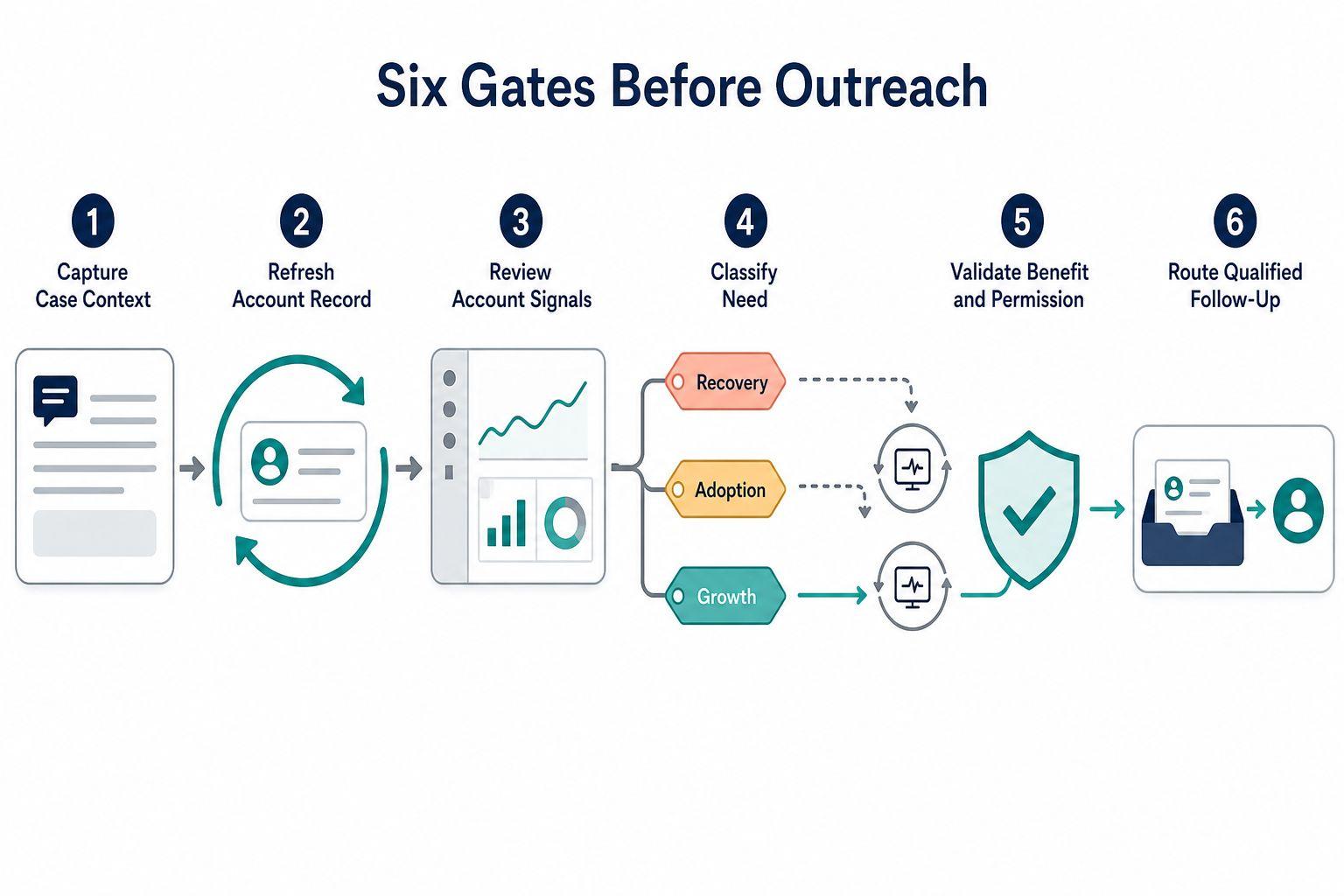
- Capture case context in CRM at the moment of resolution, including the specific limitation or need the customer described, in their words.
- Refresh the account record before drawing any conclusion, since B2B firmographic and stakeholder data decays quickly and a signal read against stale data is unreliable by default.
- Check health, adoption, sentiment, renewal status, and stakeholder fit together, not in isolation, because a strong health score with a weak stakeholder map is not the same finding as the reverse.
- Classify the case as recovery, adoption friction, or growth signal, using the same categories introduced earlier, and stop there if it is not a growth signal.
- Validate customer benefit and permission by confirming the signal reflects a need the customer has actually stated or demonstrated, not one the team wants to see.
- Route the qualified follow-up to the correct owner, with the context attached, rather than to whoever is available.
The Minimum CRM Record
A usable record needs, at minimum, the case summary, the account’s current lifecycle stage, the last verified stakeholder list, and the health score components that produced the current reading. Anything less and step three above cannot be performed honestly.
Where the Handoff Rule Fits Inside That Record
A signal only moves to an account owner once it clears validation. The customer success manager is accountable for the accuracy of the outcome context passed along, not for the conversion rate of every case that crosses their desk. That distinction protects the manager from an incentive to inflate signals just to hit a handoff quota, which is precisely the pressure that erodes trust fastest.
Align Ownership and Measure Influence Without Distorting It
Clear ownership prevents the same account from getting three different, uncoordinated messages from three different teams in the same week. It also prevents responsibility for a bad outcome from diffusing until nobody owns it.
Support, the customer success manager, and the account owner each carry a distinct piece of the sequence, and the split holds across five moments:
- At signal capture, support logs case context accurately at resolution while the manager confirms it reflects a real pattern; the account owner has no role yet.
- At validation, support supplies ticket history on request, the manager owns the classification decision, and the account owner reviews only cases already marked as a growth signal.
- During recovery, support owns resolution and follow-up on the incident while the manager monitors sentiment afterward, and the account owner stays out unless renewal risk emerges.
- Ahead of renewal, support escalates unresolved issues before the renewal date, the manager coordinates a health review with the account owner, and the account owner owns the renewal conversation itself.
- At expansion follow-up, support has no direct role, the manager supplies outcome evidence to support the case, and the account owner owns the commercial conversation.
Retention, adoption, time-to-value, expansion influence, and sentiment need to stay on separate lines in any reporting view. Collapsing them into a single revenue figure lets a strong quarter of expansion bookings hide a quiet decline in sentiment or a slipping time-to-value number, and that gap tends to surface as a churn spike a few quarters later, well after the team that caused it has moved on to other accounts.
Scale the System With a Customer Success Platform and Bounded AI
A customer success platform earns its place when it centralizes the journey stage, health score inputs, and handoff history in one record that support, success, and account teams can all see without asking each other for a status update. That alone removes a meaningful share of the stale-context problem described earlier, since nobody is working from a three-month-old snapshot.
Whether such systems get replaced by AI is a narrower question than it sounds. Within the scope that matters here, AI can help organize signals, surface patterns across a large account base, and flag records that need refreshing faster than a person scanning a queue.
It does not replace the judgment call about whether a signal is real, and it does not replace the account owner’s read on a buying committee.
Renewal coordination and data quality remain accountable to a person, and any centralization of account data has to be handled with the same care given to other regulated customer data, which is the context in which GDPR and SOC 2 belong in this conversation, as governance boundaries rather than features.
Prove the Motion in the First Forty-Eight Hours
The system above is not something to roll out account-wide before it has been tested against real cases. An audit has to come first, because it tests relevance and trust risk on a small, reversible scale before anyone commits a workflow change across the whole support and success organization.
Start the audit today, on whatever cases closed this week, before anything else on this page happens. That ordering matters because every later step, from field-filling to the leadership review, depends on the sample being current rather than convenient.
- Audit a small sample of recent enterprise cases first, ten to twenty is enough, and note the outcome at stake and any unresolved adoption barrier in each. This has to happen before the fields get added, because the sample defines what the fields need to hold.
- Add health, stakeholder, owner, and follow-up-fit fields to those same records next, filling in only what can be verified, leaving the rest blank rather than guessed. This step depends on the audit above it and cannot be shortcut by templating the fields in advance.
- Review the classifications with support and account leadership together last, checking specifically for cases where a recovery ticket was nearly treated as a growth signal, since that is where trust gets spent. This comes third because the review is only honest once the first two steps have produced something real to look at.
What that review turns up, whether the sample held three real signals or none, is what decides whether the workflow scales next quarter or gets tightened first. Either answer is useful.
About the Author