

What would it take for an internal stakeholder to look at a signed marketing contract, six months in, and conclude that the money produced qualified projects rather than a folder of unqualified calls?
Most electrical contractors cannot answer that question before they sign, because the agencies pitching them describe channels and promises, not evidence tied to the two acquisition outcomes that actually matter. That gap between marketing activity and project acquisition is where budgets get lost.
Commercial wiring work and residential upgrade work are sold, priced, and evaluated differently, and an agency that cannot separate the two in its own reporting is unlikely to separate them in a campaign.
Why Is Choosing an Electrician Marketing Agency Different for Premium Projects?
A general contractor lead-generation pitch treats “electrician leads” as one category. Premium buyers do not.
Commercial wiring projects typically involve longer consideration periods, multiple stakeholders (property managers, general contractors, facility owners) and procurement steps that a residential homeowner never touches. Residential upgrade projects move faster but depend heavily on local search intent, how quickly a call gets answered, and whether the person answering can qualify a panel upgrade from a nuisance service call.
Because these are separate acquisition problems, the agencies chasing them need to be evaluated on separate terms. Lead volume, the number most agencies lead with in a sales call, says nothing about which of these two outcomes was produced, or whether either was produced at profitable cost.
The comparison that actually holds up under scrutiny runs across five dimensions applied consistently to every candidate.
- Market fit asks whether the agency understands the service area and the target buyer for each project type.
- Offer and channel fit asks whether proposed channels match how commercial and residential buyers actually search and decide.
- Proof covers case studies, testimonials, references, and a visible service portfolio tied to electrical work.
- Measurement is whether reporting connects marketing activity to booked jobs and revenue.
- Commercial terms covers pricing structure, ownership of assets and data, and contract flexibility.
None of these dimensions overlaps with another, and together they cover everything a decision-maker needs to defend a vendor choice internally. An agency that scores well on one and is silent on the rest has not been evaluated. It has been pitched.
What Should Be Compared Before Any Agency Is Shortlisted?
Before any proposal gets weighed on price or personality, the same fixed criteria have to be applied to every candidate, in the same order, so the comparison is not accidentally shaped by whichever agency presented last or spoke most confidently.
Six checks belong on that list, and each one produces a specific piece of evidence rather than a general impression:
- Electrical-service and target-audience understanding. The agency should be able to describe, without prompting, the difference between a commercial wiring buyer and a residential upgrade buyer, and how each searches, qualifies, and closes.
- Service-area and competitive-market planning. Ask for a description of the actual service radius and the competing contractors inside it, not a generic radius map pulled from a template.
- Channel and creative capabilities. The agency should show which channels it manages directly (search, paid ads, Google Business, video, social) versus which it subcontracts, since subcontracted execution changes accountability.
- Case studies, testimonials, references, and service portfolio. These need to be electrical-industry specific, not adjacent home-service examples dressed up as equivalent.
- Transparent pricing and ownership. Contract terms should state, in writing, who owns the website, the ad accounts, and the tracking data if the relationship ends.
- Reporting methods. The agency should be able to describe, before any contract is signed, what a monthly report contains and how it ties activity to booked work.
Each of these six items exists to answer a version of the same underlying question: can this agency’s claims be checked against something concrete, or does the pitch rely on the buyer taking its word for it?
A contractor evaluating three agencies side by side will usually find that one or two collapse under item four or six almost immediately. That collapse is useful information, not a reason to soften the criteria.
Skipping any one of these six, even the ones that feel like formalities, converts the entire selection process into a guess dressed up as due diligence.
Which Channels Must an Agency Match to Commercial Wiring and Residential Upgrades?
Channel selection is not a menu an agency gets to choose from based on what it already knows how to run. It is a fit test: each proposed channel has to be justified against the project type it is supposed to acquire, and an agency unable to make that case is proposing tactics, not a strategy.
What Commercial Wiring Projects Require From a Channel Plan
Commercial work depends on reaching the right decision-maker inside a longer sales cycle, so the channel mix has to include service-area targeting aimed at property managers, general contractors, and facility owners rather than homeowners.
Search visibility matters, but so does having credible proof assets, case studies and a portfolio a specifier can review before ever picking up the phone. Because commercial inquiries are fewer and higher value, qualified inquiry handling (how a call or form submission gets triaged before it reaches an estimator) carries more weight than raw traffic numbers.
What Residential Upgrade Projects Require From a Channel Plan
Residential acquisition leans on local search presence and disciplined Google Business management, since panel upgrades and rewiring jobs are frequently searched with immediate local intent. Google Ads or Local Service Ads suitability depends on the contractor’s capacity to handle inbound call volume, and paid-ad response paths need to route to someone who can qualify the job on the first call.
Social or video support is worth including selectively, mainly to build trust ahead of an in-home estimate, not as a primary acquisition channel.
An agency worth shortlisting, often described as an electrician digital marketing company, should be able to explain in plain terms why each channel on its proposal maps to one of these two project types, rather than presenting a standard package built for generic home services.
How Does an Electrician-Fluent Agency Compare With a General Local Agency and DIY?
Specialization is not a verdict by itself. An agency that has worked exclusively with electrical contractors can still fail on measurement discipline, and a general local marketing agency with electrical clients on its roster can sometimes document results a specialist cannot. The comparison has to run on demonstrated capability, checked against the same five dimensions used everywhere else in the evaluation, not on the label an agency puts on its homepage.
| Option | Electrician-Market Fit | Measurement and Execution Burden | Best-Fit Condition |
|---|---|---|---|
| Electrician-fluent agency | Understands commercial vs. residential buyer paths, service-area competition, and proof requirements specific to electrical work | Should already have reporting built around booked jobs and lead quality, reducing setup burden | Preferred when case studies, references, and reporting are electrical-specific and verifiable |
| General local marketing agency | May understand local search and paid media well but often lacks electrical buyer nuance without a documented track record | Reporting frameworks may need to be built or adapted, increasing early oversight burden | Viable when it can produce comparable electrical results and the required capabilities in writing |
| In-house or DIY effort | Full contractor-level knowledge of the trade and its buyers, but marketing execution depends entirely on internal skill | Full burden falls on internal staff for channel management, tracking setup, and reporting | Viable when internal capacity can execute and measure consistently without diverting estimator or crew time |
The default position favors the electrician-fluent agency, because it starts closer to understanding both acquisition paths and typically arrives with reporting habits already built for this work. That default is not fixed.
It flips in two specific conditions.
- A general local agency earns equal standing the moment it can document comparable electrical results, alongside:
- the same case studies,
- references, and
- pricing transparency required of a specialist.
- And DIY becomes the rational choice when the contractor has internal staff capable of:
- running channels and
- building attribution reporting without pulling time away from:
- estimating or
- crew scheduling, since an unmeasured DIY effort is worse than either agency option.
What Evidence Proves That an Agency Can Win the Right Projects?
A polished portfolio is not evidence. It is marketing about marketing, and it should be read that way until it survives a closer inspection.
A case study worth accepting states the project type, commercial wiring or residential upgrade, along with the service area it was run in and the target audience it was built for. It should name the acquisition route, whether that was organic search, paid ads, referral, or a combination, and it should define how lead quality was measured for that specific engagement. The outcome needs to sit in context rather than isolation: a number without the conditions that produced it is not a result, it is a claim.
Case studies for commercial electrician marketing specifically should be treated as a required proof category on their own, since commercial acquisition behaves differently enough from residential work that a residential-only portfolio cannot stand in for it.
Testimonials and references need the same scrutiny. A testimonial with no named business, no verifiable project type, and no way to contact the source is not a reference, it is copy.
A live reference call, where a decision-maker can confirm the project type, the lead quality, and the reporting experience, carries far more weight than any quote on a website.
The service portfolio and pricing model deserve the same read. An agency that lists channels without service-area or industry specifics, or that will not put pricing and scope in writing before a contract is signed, has left a gap that should be treated as a gap, not filled in with assumption or good faith.
How Should Reporting Connect Leads to Booked Jobs and Return on Investment?
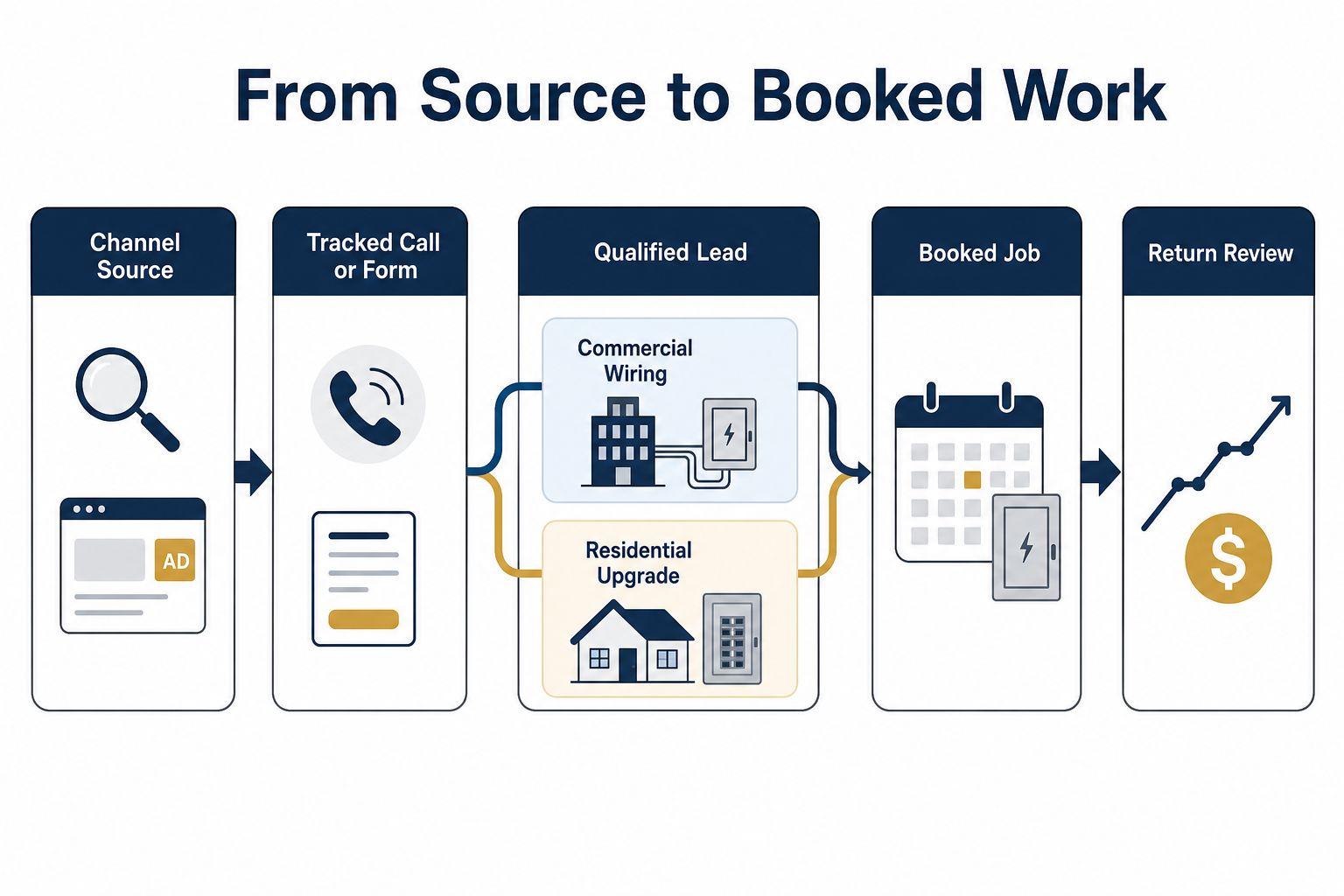
Reporting is where the entire evaluation either holds up or falls apart, because reporting is the only mechanism that shows whether an agency is optimizing for booked projects or simply generating activity that looks good in a screenshot.
A monthly report worth paying for has to connect source-level marketing activity to what actually happens after the phone rings. That means it should include, at minimum:
- Call tracking: which channel and campaign generated each call, tied to a recorded or logged conversation.
- Lead quality: a stated definition of what counts as a qualified lead for each project type, not a raw count.
- Booked jobs: how many tracked leads converted into scheduled or completed work.
- Conversion rate: the percentage of leads that became booked jobs, by channel and by project type.
- Cost per lead and return on investment: cost against both raw leads and booked jobs, so the two numbers cannot be conflated.
- Customer lifetime value: included where available, particularly for residential clients likely to need repeat electrical work.
- Organic traffic and local search ranking: trend data showing whether visibility is improving independent of paid spend.
Two of the channels named above are frequently confused, and an agency’s ability to explain the difference is itself a test. As Google’s own ad-solutions comparison frames it, Google Ads is a pay-per-click model, while Local Services Ads runs on a pay-per-lead basis. An agency proposing both should be able to state plainly which model applies to which line item in the invoice, and why.
What the Reporting Relationship Should Cover Beyond the Monthly Numbers
Beyond the list itself, the reporting relationship needs a clear attribution approach, stated in advance. It also needs an escalation process for what happens when leads come in poor quality, a defined path for flagging and adjusting, not a vague promise to “look into it.”
Multi-location or franchise reporting only matters where a contractor actually operates across locations, and even then, no claim about regional performance differences should be accepted without the agency’s own data behind it.
Which Observable Signals Mean an Agency Should Be Rejected Today?
Every dimension covered so far converges on one working rule: an electrician-fluent agency with verifiable proof and disciplined measurement is the default choice for both commercial wiring and residential upgrade acquisition. That default flips when a general agency can document equivalent electrical results and the same reporting rigor in writing, or when internal staff can execute and measure DIY work without proof-of-concept risk.
What should not survive negotiation is a set of observable absences, each one a documented fact rather than a hunch.
Walk away if the agency cannot show project-type-specific evidence, cannot name how calls and booked jobs are attributed, reports impressions or raw lead counts without defining lead quality, will not put pricing, scope, and ownership terms in writing, proposes channels without connecting them to service area and competition, or refuses to provide references.
Any one of those, on its own, is enough. None require interpretation.
About the Author